G Says…
This week we’ve been driving down narrow lanes, walking on beaches and cliff tops and taking advantage of some glorious weather to explore what is surely England’s most photogenic county. This blog post is a melange of several days out in this spell of delightfully warm weather.
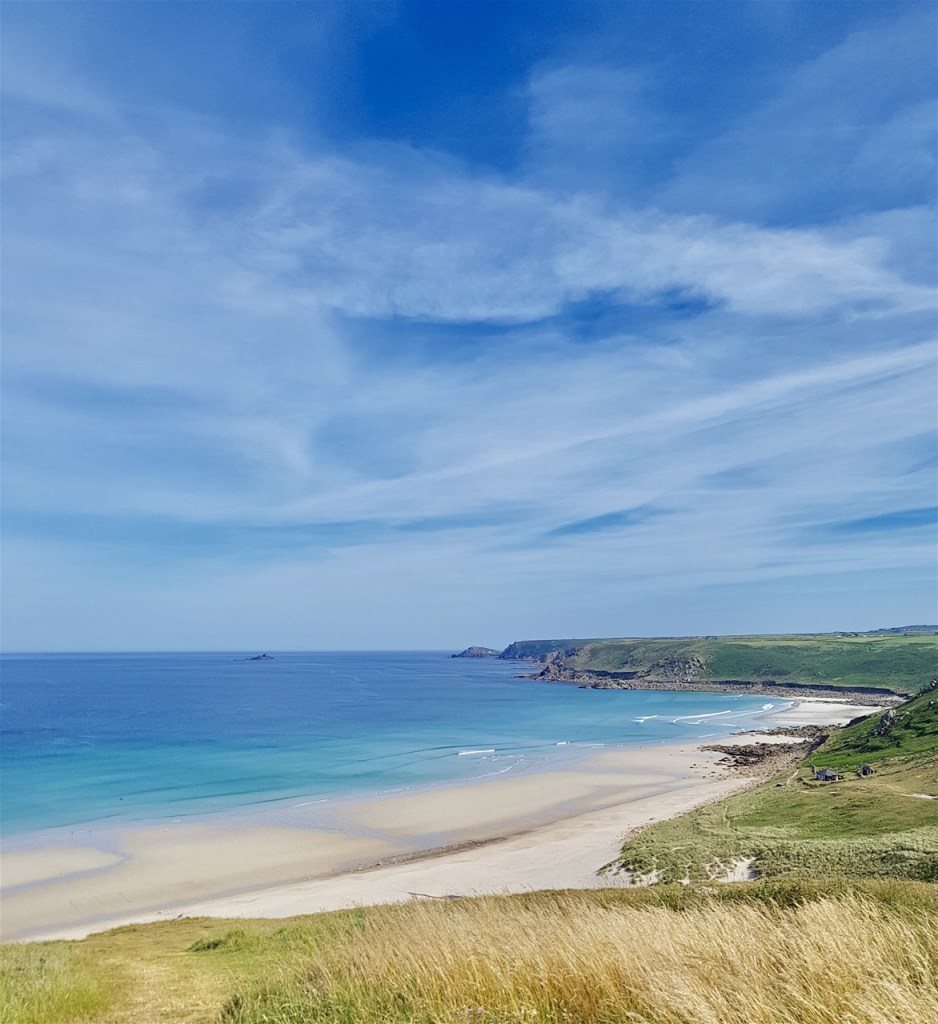
Cornwall is a big place, long and narrow, with the longest coastline in Great Britain. A lot of coastline means a lot of beaches and we’ve walked on beaches in the past few days that are equal to any we’ve seen anywhere in the world and we’ve been almost everywhere! Blue sky and sunshine help, of course, but golden sand and a turquoise sea are an irresistible combination.
Cornwall, or Kernow as the locals call it, is one of the seven historic Celtic Nations: the other six being Alba (Scotland), Eire (Ireland), Breizh (Brittany), Mann (Isle of Man) Cymru (Wales) and Gallaeciea (Galicia, in Spain). Not a dud among them!
Cornwall has about half a million permanent residents, but more than five million tourists a year. Those tourists eat more than 5 million Cornish pasties every year, an average of 13,500 a day. No wonder the humble Cornish Pasty is worth £150 million a year to the Cornish economy.
We love Cornwall and have done ever since our first long stay visit in the late 1960s when Marigold worked in a boutique and I delivered custom built surfboards all over Cornwall. We lived in a very small tent, stored our meagre belongings in the back of our Austin A35 van, and our friends were itinerant surfers from Australia, New Zealand and California. These days, we don’t ‘rough it’ to the same extent, but otherwise little has changed.
When we moved back to England after many years absence Cornwall was our first choice for somewhere to live. We stayed for over three years and only left when I had a very inconvenient heart attack that needed regular hospital visits. There’s one proper hospital in Cornwall, just the one, hardly ideal in the circumstances so we moved back up North again.
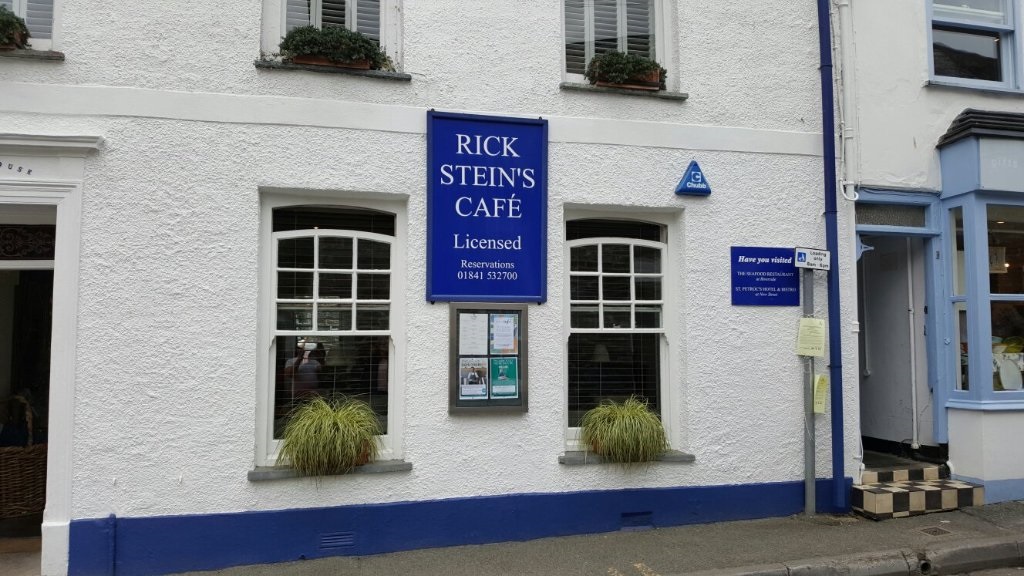
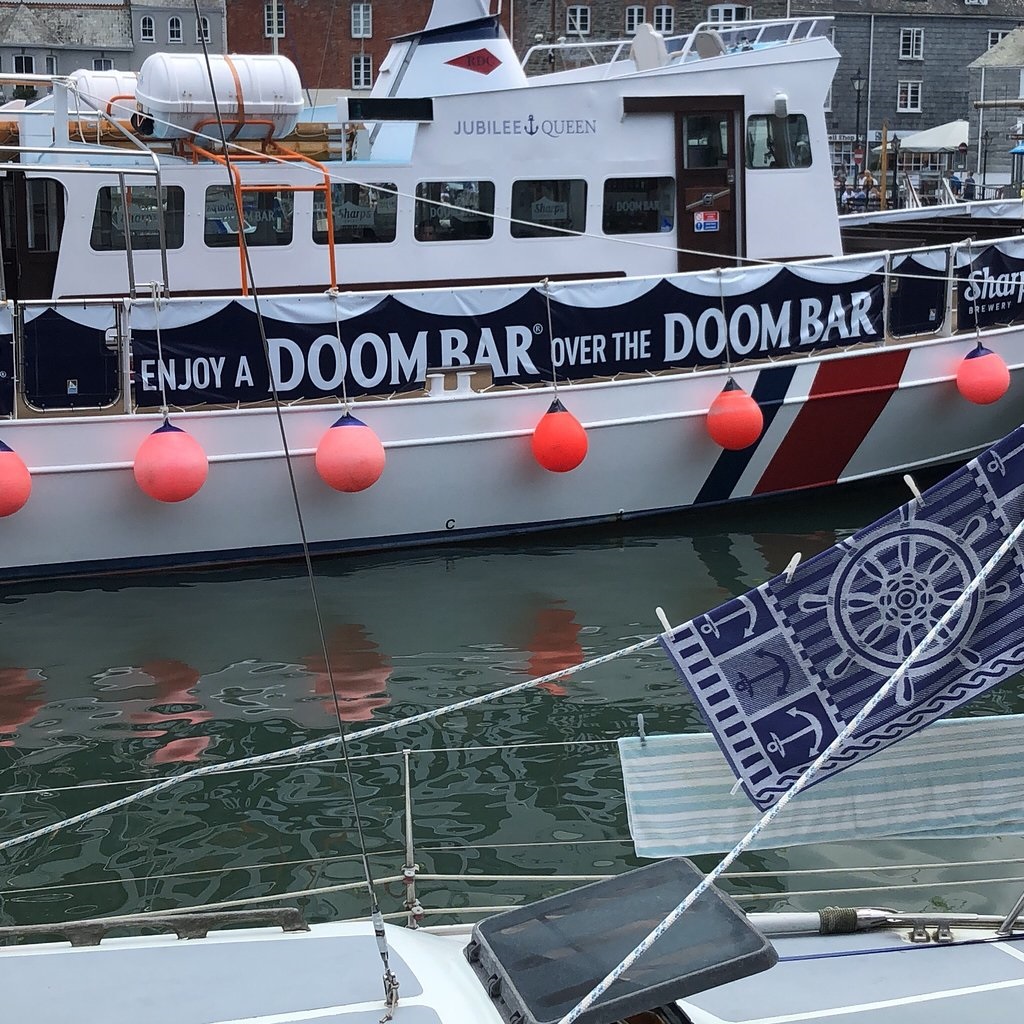
First day, Padstow. Visiting Padstow means going either early or late as the association with Rick Stein put Padstow on the map and now means this tiny fishing village is over run with visitors. We arrived in mid afternoon and wandered around for an hour or so, mingling with other tourists and feeling a very different vibe to when we lived just up the road. We could have taken a trip around the bay, a ferry to Rock just over the way or a boat trip to visit the notorious Doom Bar, but that would have required us to act like tourists.
Widely known as the brand name of the most popular beer in England, the flagship ale of the local Sharp’s Brewery, the Doom Bar is a bank of sand at the estuary of the River Camel where it meets the Celtic Sea. It can be seen at low tide and appears innocuous enough, but many ships have been wrecked there. We didn’t do any of those tourist things; we didn’t even buy a Cornish pasty or an ice cream, even though there was plenty of choice, all ‘award winning’ naturally. Just about every ice cream or pasty in Cornwall boasts of being award winning.
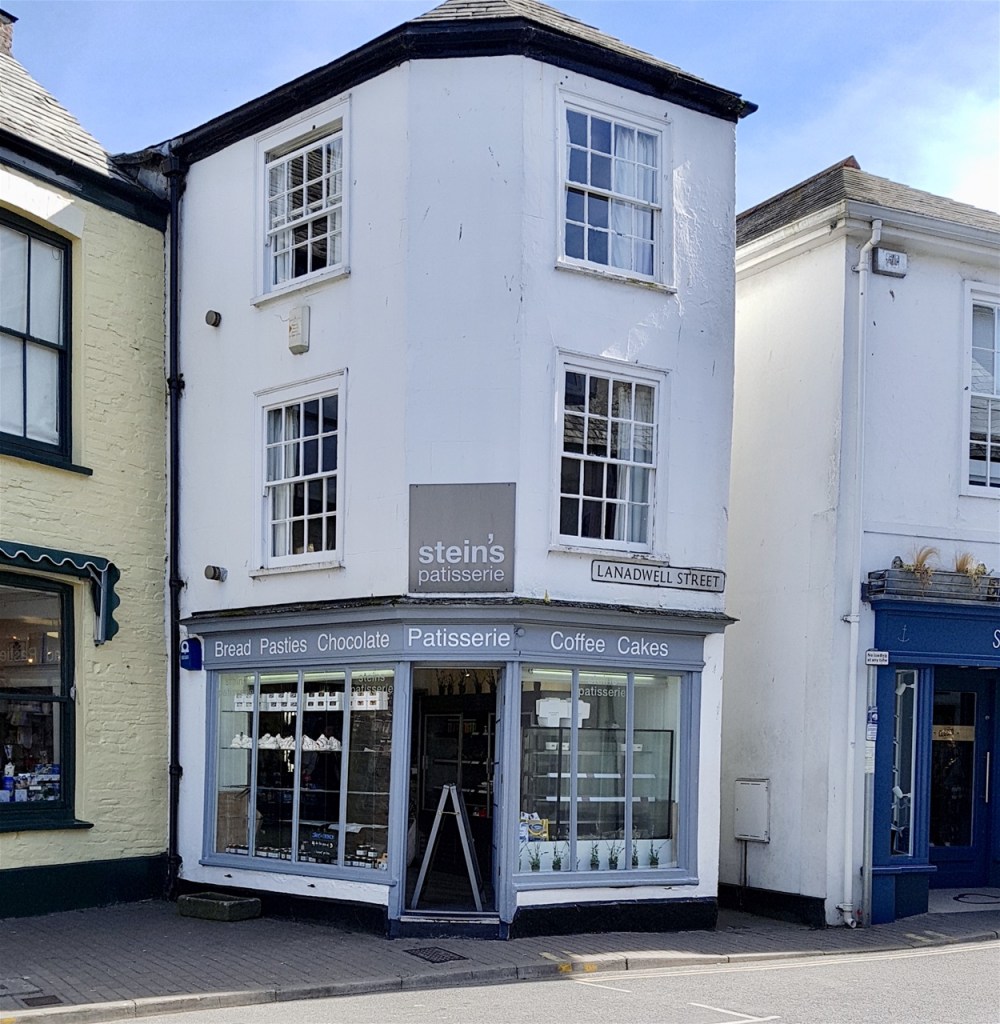
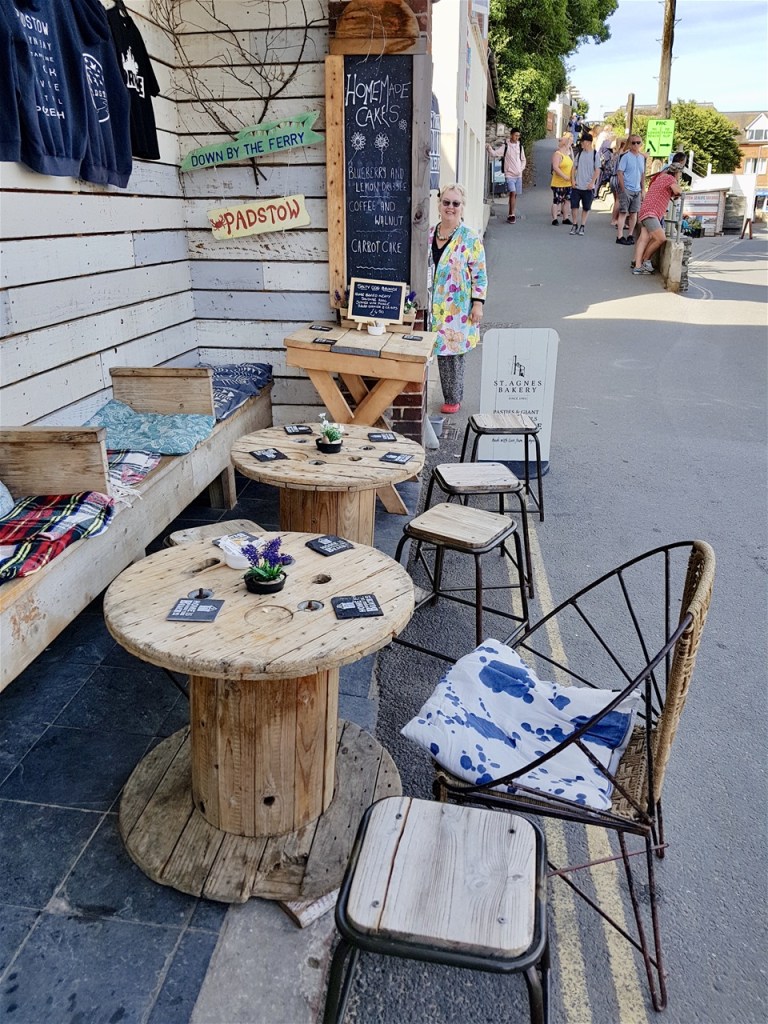
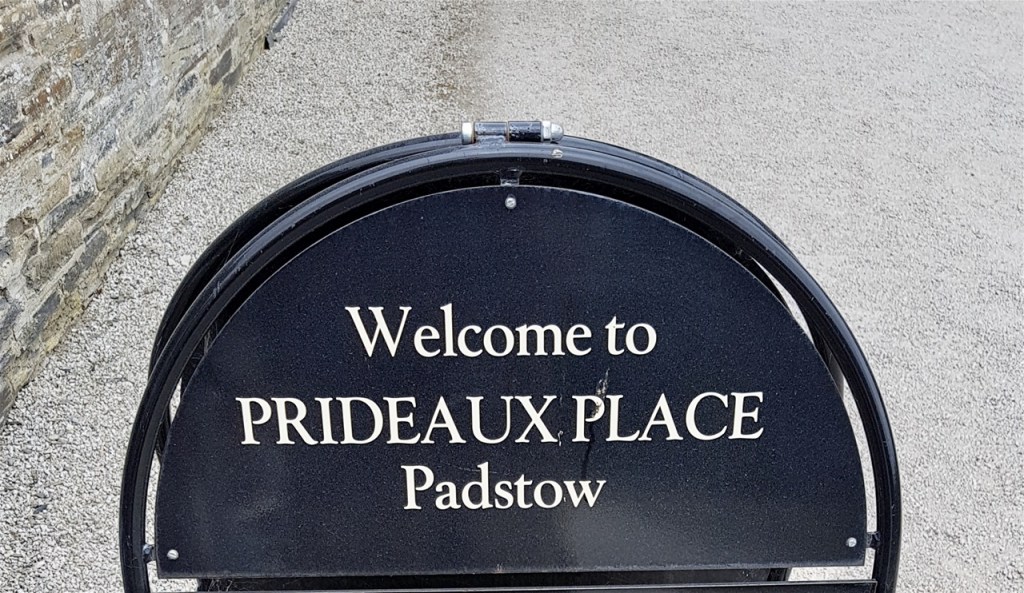
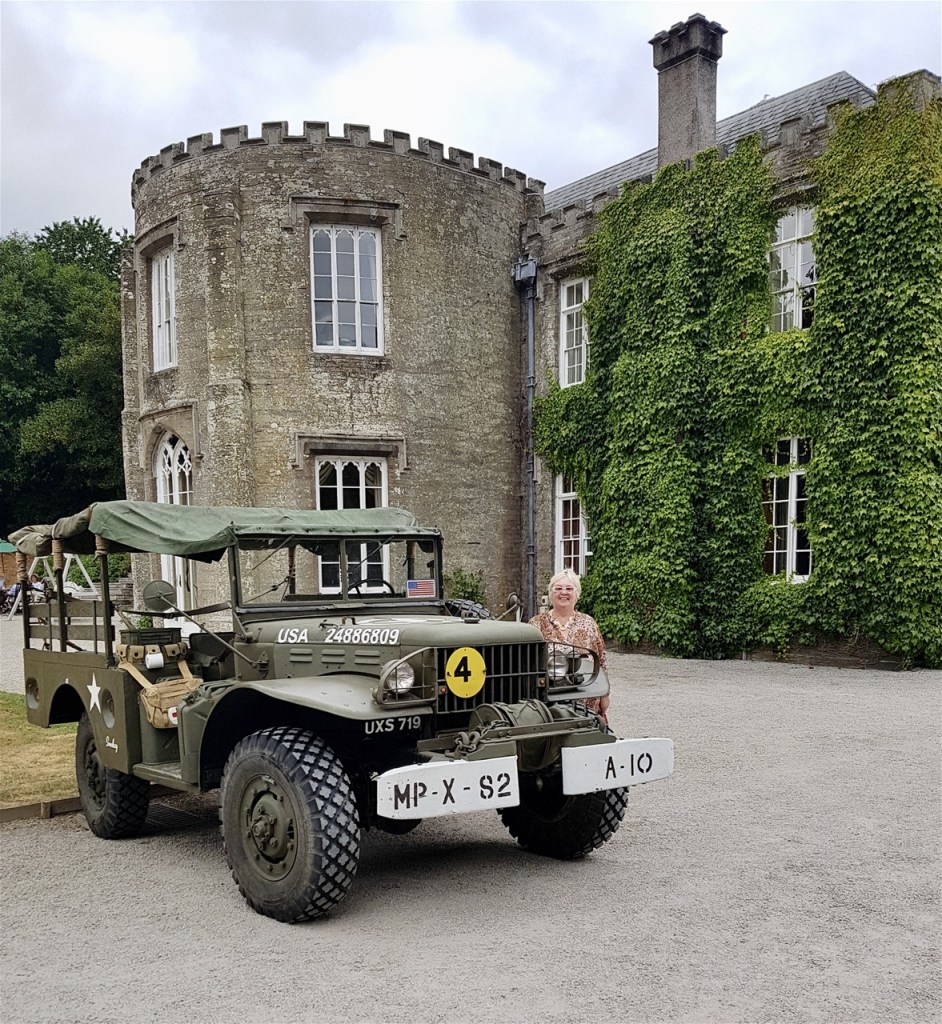
On our way out of Padstow, we drove through an ornate entrance gateway and discovered Prideaux Place, an Elizabethan Manor House, completed in 1592 by Sir Nicholas Prideaux and, over four hundred years later, still owned and lived in by members of the same family. We didn’t go inside or opt for a guided tour as it was far too nice a day to go traipsing round an old house, admiring portraits of long since departed ancestors. There was an original US army jeep parked outside which was much more interesting.
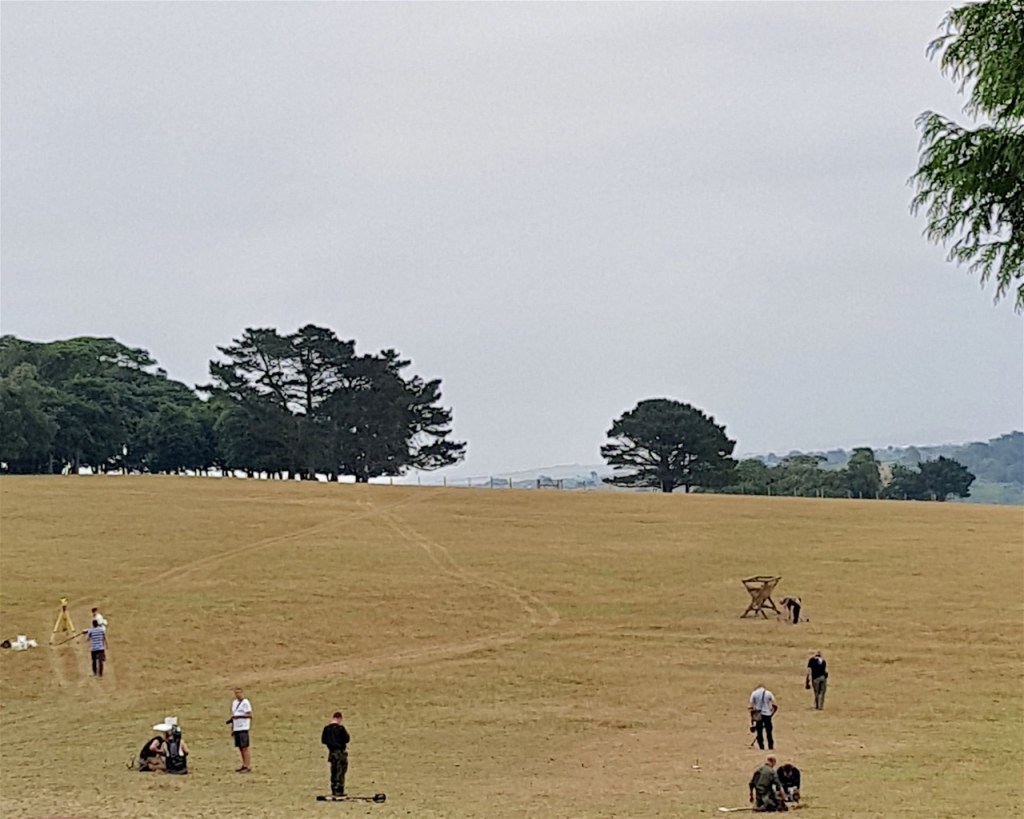
The grounds are superb, an extensive deer park especially, but the sight of a dozen ‘detectorists’ demanded our attention. Metal detector wielding enthusiasts were hard at work covering every inch of ground in search of buried artefacts. We watched for a while, but nobody uttered any shrieks of excitement as they unearthed a Saxon horde of precious metals so we gave up and left them to it.
Tintagel.
We arrived in Tintagel suffering from severe hunger pains as it had been well over three hours since we finished breakfast. I suspect this random starvation effect may be a Cornish phenomenon arising from the underground deposits of radon that are a feature of the county. We picked a cafe, no shortage of them here as Tintagel is mainly cafes and tourist tat shops concentrating on Aurthurian legends. King Arthur and the Knights of the Round Table are dominant features of the town.
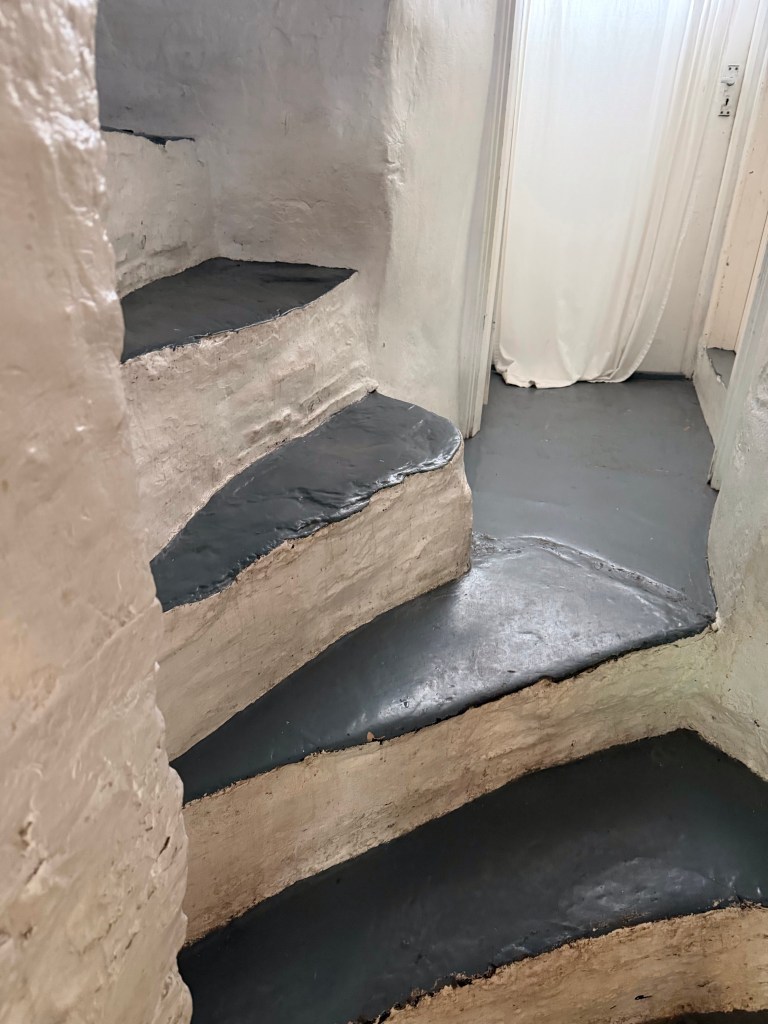
The cafe was very traditional in style and the fare on offer hit the spot. The ‘facilities’ were behind a curtain in the corner. On pushing aside a curtain I found a narrow, winding stone staircase of great antiquity, the stone steps being heavily worn by the passage of innumerable feet. On eventually reaching my destination I realised that while the staircase looked a couple of hundred years old, then the ‘rest room’ looked as if it had been installed when the Plantagenets were on the throne!
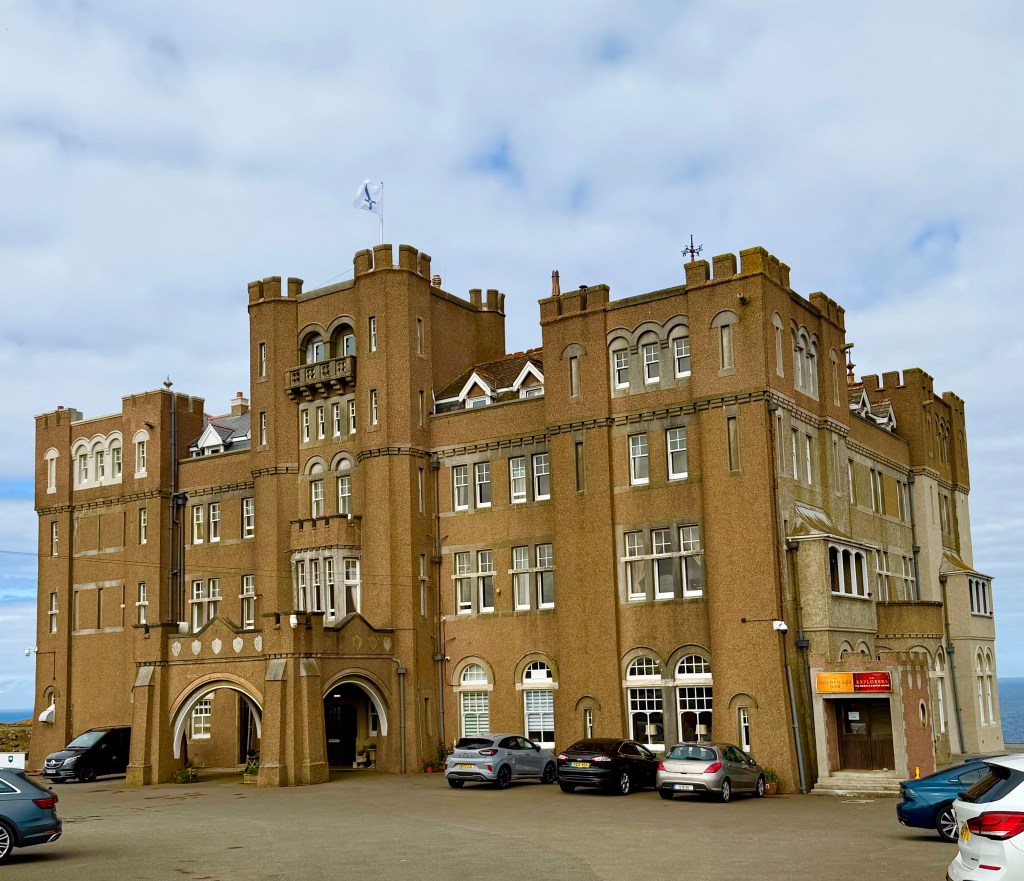
We called at Camelot Castle Hotel, as we invariably do, and met a very serious young American woman who wanted to know if the large round table that dominates the interior was the actual one from the time of King Arthur. She was so very eager for this to be confirmed that, of course, we said it was indeed and King Arthur sat directly in line with the clock on the wall. Which had a quartz movement. She nodded happily and took a photograph to show the folks back home in Indiana.
The hotel is owned by a relative of the Mappin family, of Mappin and Webb association, and he is very well thought of in the area after refusing to accept a very large sum to accept illegal immigrants as sole occupiers. As part of the deal it would be necessary to part with all his existing staff so he told the Ministry that was unacceptable and to look elsewhere.
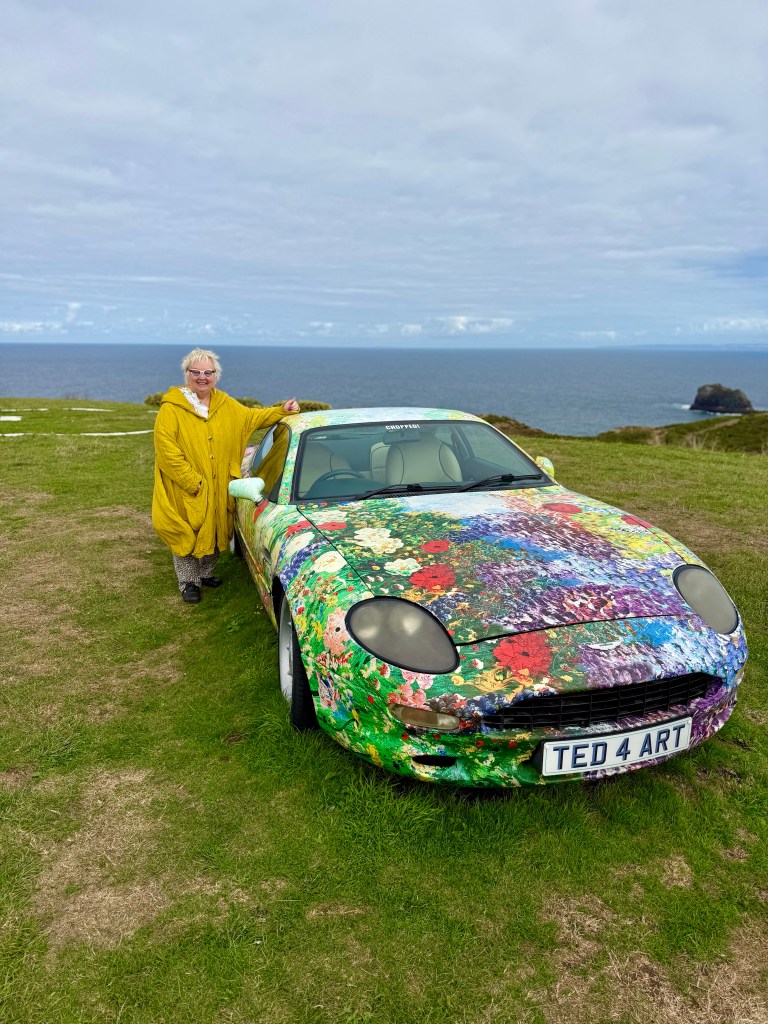
There’s a garishly painted Aston Martin on the headland featuring a colour scheme dreamed up by an Artist in Residence. We vowed never to consider buying any of his artwork.
Sennon Cove
Not been to the far tip of Cornwall for a while, so we decided to pay a visit. No, not Lands End which would be an over-commercialised waste of our time. We drove there, just in case it’s improved, past the First and Last pub in England – depending which way you’re heading – and could see at a glance it’s still just a second rate theme park so we went to Sennon Cove instead.
Many years ago I remember this being one of the best places for surfing and there were surfers here aplenty today, all with glum faces as a strong wind was blowing but the waves were almost non existent. We drove onto the cliffs, stopping a very long way from the edge, and we were lucky enough to see not one but four Cornish choughs, battling against the wind practically at eye level. It was incredibly windy and not a day for birds with errands to run.
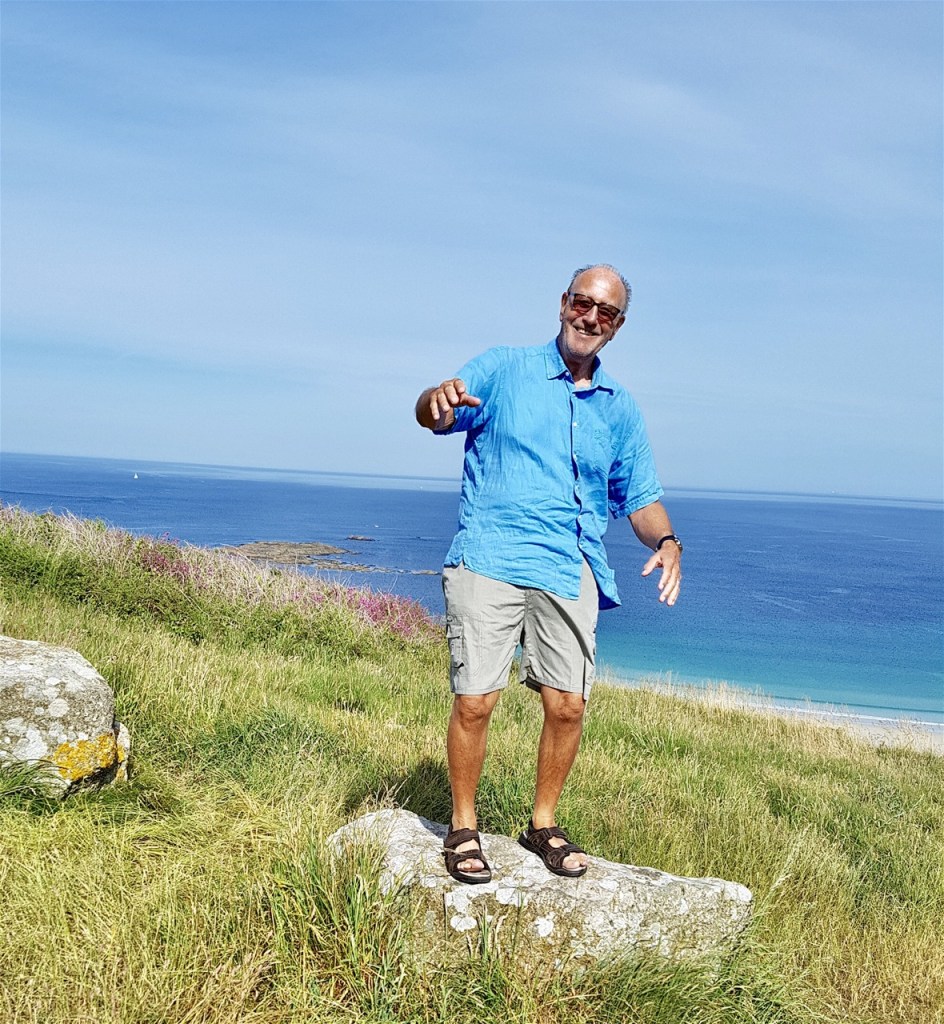
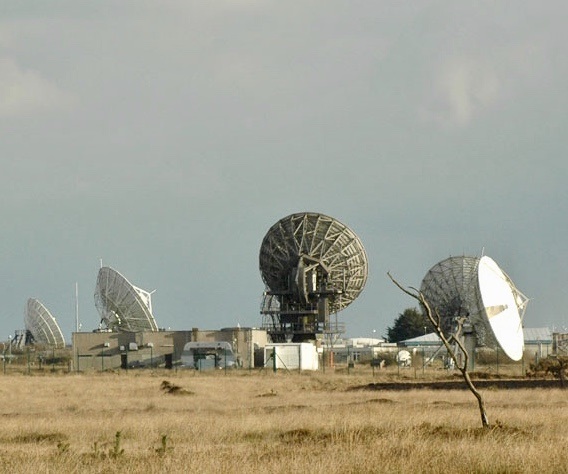
We went to look at, if not actually explore as security is understandably tight, the Goonhilly complex near Helston; the site of the world’s first first parabolic satellite antenna. That disc, installed in 1962 and named ‘Arthur’, was built to monitor the ground breaking Telstar satellite and handled the first ever ‘live’ TV broadcast via satellite.
At one time the Goonhilly station was the largest of its kind on the planet with more than 60 dishes and it’s still an impressive sight.
That first transmission using Telstar to bounce a tv signal around the curvature of the Earth transmitted its first image – a video of a wind blown flag outside a TV station in Andover, Maine – on July 11, 1962, but it was the historic broadcast 13 days later that captivated my teenage imagination.
The Telstar satellite relayed the first ever live transatlantic broadcast. Walter Cronkite and Chet Huntley – newscasters on rival TV stations – and the BBC’s Richard Dimbleby hosted the show. The program started with a picture of the Statue of Liberty and the Eiffel Tower side by side, each coming from different sides of the world.
I can remember the quality being far from perfect, a fuzzy picture and a noticeable time lag, but everyone was talking about it for days afterwards. Now, we take this technology for granted, but back in 1962 this was truly astonishing and only the televised pictures of a Moon landing seven years later was deemed sufficiently remarkable to beat it.
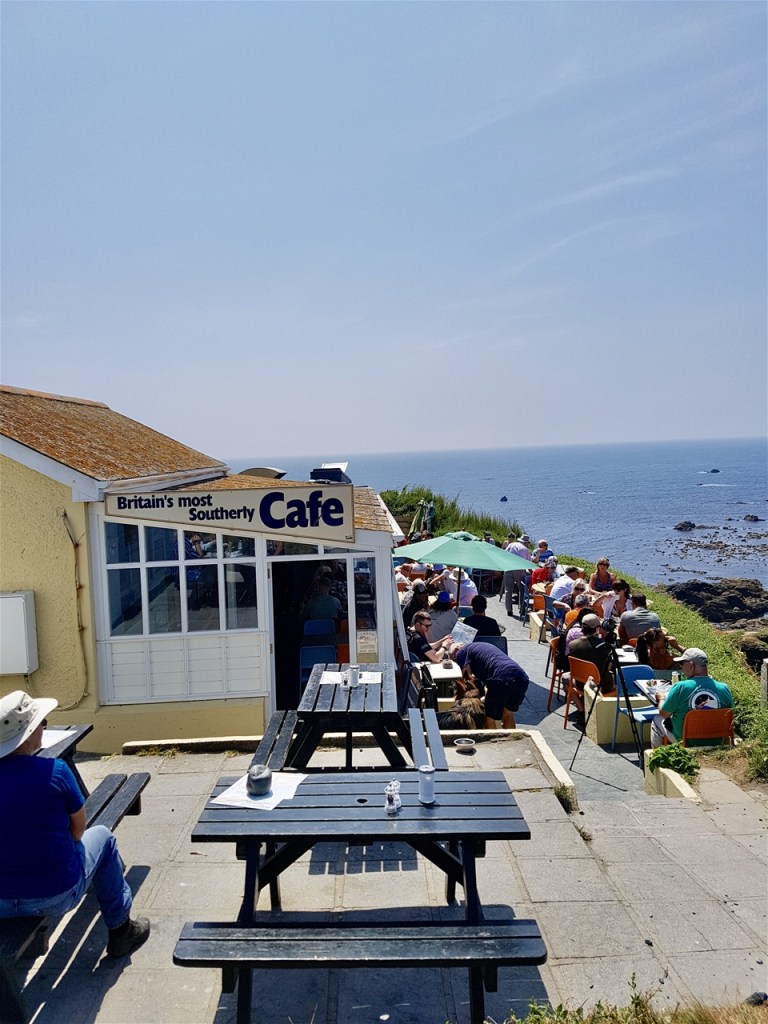
Next stop was Lizard Point, complete with the Last Cafe in England. There’s no ‘first cafe’ this time as the cafe is perched on the actual furthest point so to claim it as the ‘first’ would only be appropriate if approached from the sea.
The rocky coast of Cornwall has been the scene of many shipwrecks and Lizard Point was the scene of the greatest ever sea rescue by the RNLI.
There’s a plaque commemorating the rescue of all the 456 passengers from The Sueric which ran ground on rocks while sailing from Australia to Liverpool in March 1907. Sixty volunteer crewmen from Cadgwith, Coverack, The Lizard and Porthleven rowed back and forth for 16 hours to rescue the passengers, battling huge waves and ferocious winds in open boats and saved 456 lives, including the 70 babies onboard, without a single life being lost.
We chatted to a couple of well equipped hikers, with all the correct gear, who looked on the verge of exhaustion. Marigold asked how far they’d walked today and the lady walker looked a little surprised.
‘We’ve just got here,’ she said. ‘Not even started yet,’ indicating their car parked right next to ours.
Oops!
We told them we were intending to go to Kynance Cove next and they told us it costs £5 at the National Trust car park, then a long hike, twenty minutes for ‘walkers -so that’s at least half an hour for us – before reaching sea level.
‘We’re National Trust members so parking is free for us,’ they gloated.
Yes, of course they are. We’re not. We’re also fairly well down the path of decrepitude so Kynance Cove no longer seemed such a good idea.
We moved on instead to Cadgwith Cove, a pretty fishing village with a pub and not much else. About twelve years ago we came here over Christmas and the New Year, rented a cottage right on the harbour and we haven’t been back since. Not that we didn’t have a good time, far from it, but there’s so much more of the world out there to see!
‘Our’ cottage wasn’t very comfortable, as I recall, the bedroom was dark, dingy and a bit damp in the depths of winter, there was no tv, the oven didn’t work, you get the picture? Christmas dinner, ingredients sourced from far, far away Marks and Spencer in Hayle, was a ‘no oven or hob’ style disaster, but when the tide came in, sea spray battered the windows, the surf pounded on the rocks and it was glorious.
The whole village turned out to swim in the sea, in fancy dress, they suspended a galleon, decked out in coloured lights, from one side of the harbour to the other to resemble a brightly coloured ship on the horizon and we still talk about the characters in the pub where dogs wandered around freely and a group of fishermen gave an impromptu recital of sea shanties. We missed out on festive food, but enjoyed Christmas immensely.
Today, it’s more or less as we remember. There are a few more houses, almost certainly holiday homes, on the hillside and the fishing boats are drawn up on the beach. Not much to do here if you’re young, I imagine, but we’re not so we didn’t mind.
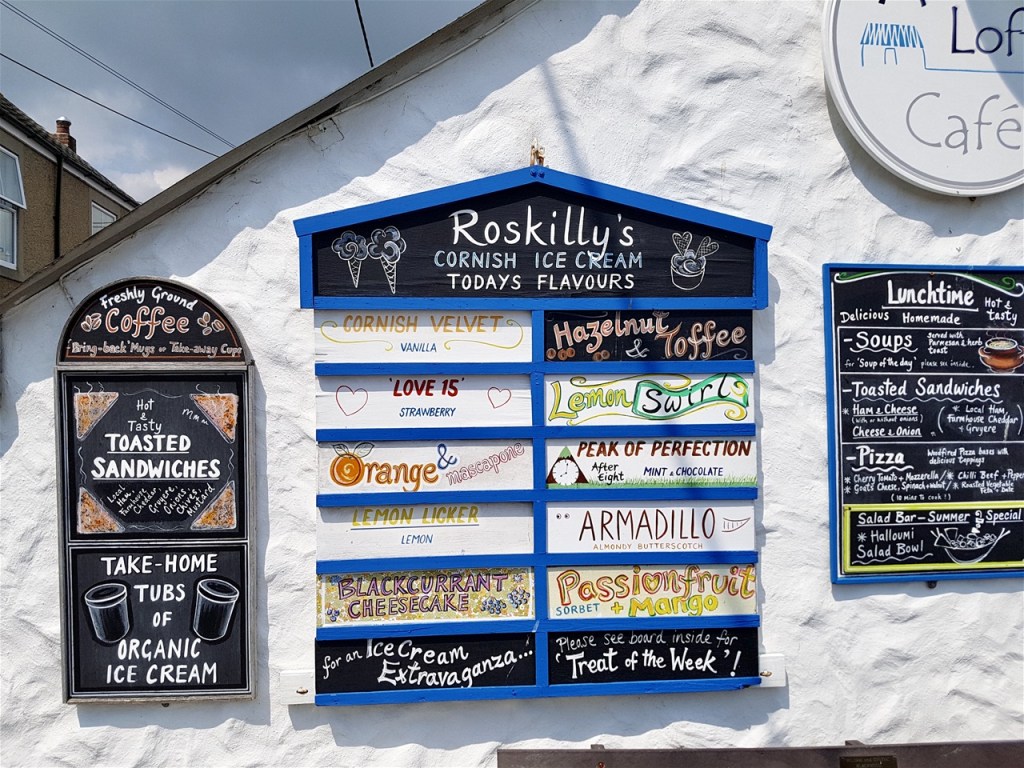
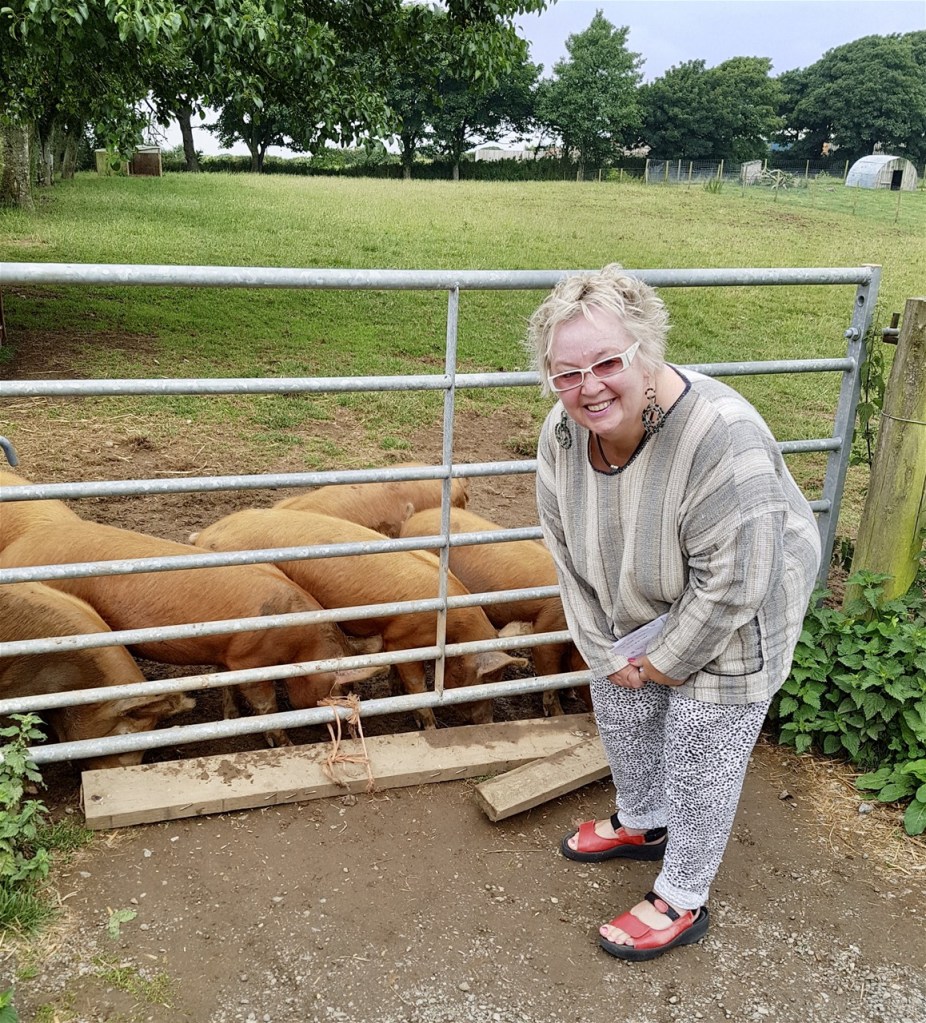
We drove up the far side of the cove, somehow managed to get lost and, completely by accident came across Roskilly Farm where they make cheese, ice cream and many other delicacies. We parked up and were admiring a group of piglets, grubbing about in a field, when two old women turned up. ‘Two mad old biddies’ was Marigold’s version.
One said to the piglets, ‘Guess what? I just had a bacon sandwich’ and cackled energetically. Very energetically, which was pretty remarkable considering it was her 80th birthday today. She told us her name was Maud and her friend, aged 83, was Ursula. Perfectly suited names.
‘If you go in the cafe, over there,’ Flora advised, ‘watch out for the cat, he’ll have your arm off if you don’t give him any milk.’ She cackled wildly, again. It was relatively early in the day or I’d have suspected Maud and Ursula had been imbibing freely. Maybe they brought their own supplies.
Marigold asked Maud if she knew where to find the sculpture park above Coverack, our next destination.
Maud frowned. ‘Ask them at Paris Hotel for best route to the sculpture park. I’m hopeless with directions.’
Ursula said, ‘It’s a nightmare. Up hill all the way, then there’s just things sat in a field. Not what I call art. Had more fun in Sainsbury’s.’
‘Take no notice of my friend,’ insisted Maud, ‘she’s got no appreciation of art at all. Ask at the Paris Hotel. They sort things out for me at the Paris, no problem. Nothing to do with France, the name, you know, but I’m saying no more.’
Ursula joined in. ‘No, nothing to do with France. I should think not too. My late husband had a word for France and French people. I can’t possibly repeat it.’
‘Ursula’s late husband was in the Diplomatic Service,’ Maud confided. ‘You get a rounded view of the world in the Service, but far too much association with foreigners for my liking. Don’t you forget about that vicious cat, now. Jumps on the tables, likes milk but prefers cream.’
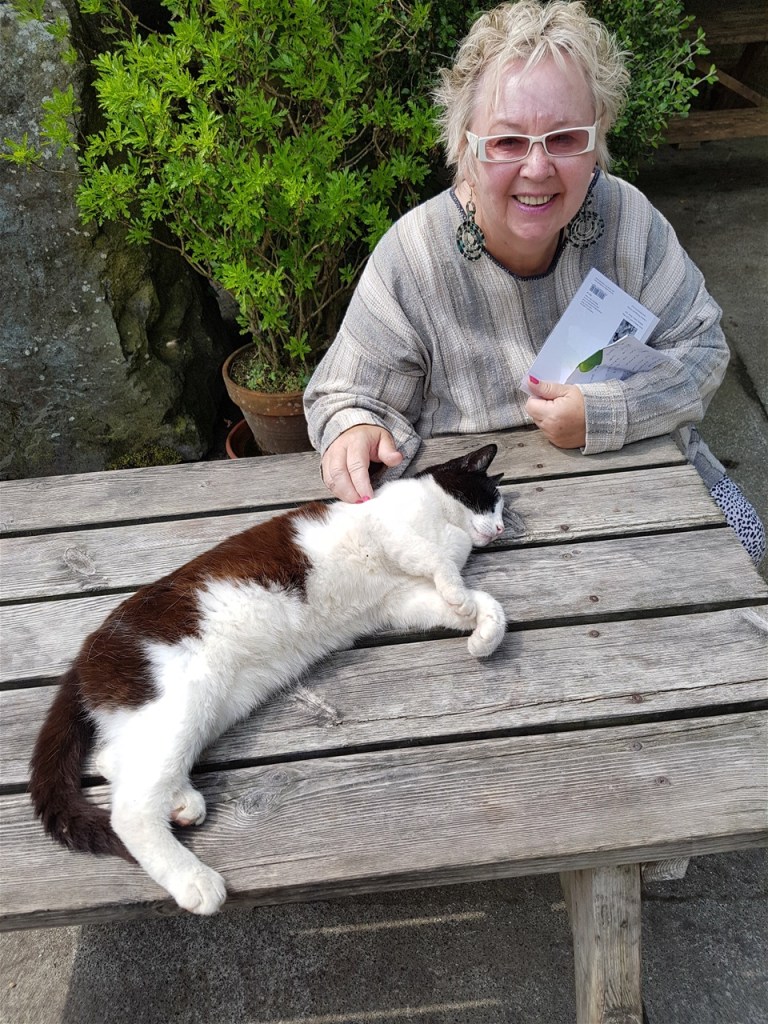
They wandered off and we decided we’d risk the cafe, despite the grave expressions of concern about potentially lethal cats. We spotted the killer feline straight away and, as Maud had warned, he was perched on a table in the courtyard, sipping milk from a spoon offered by a customer. He looked too fat to be dangerous and so it proved.
When we sat down for a moment, one of those stone in shoe problems, he waddled over, jumped up and began purring. We had no milk on offer, let alone cream, but he allowed us to live a little longer!
We moved on again to Coverack, Another place we’ve been to before and we actually stayed briefly in a cottage here a few years ago. We noted the Paris Hotel, set back from the road, on our way in.
We didn’t bother to go in and ask for directions, but we did discover it was built by the Redruth Brewery in 1907 and named after the liner SS PARIS which ran aground on the headland on Whit Monday 1899. So, the mad old biddies were right, no direct connection to France.
Marigold said she remembered a cafe on the right hand side from our previous visit, but the only one we found was the Harbour Lights cafe, which wasn’t so familiar. It was waitress service, we were advised, and sat down and watched cars trying, in vain, to find a parking space. It appeared we had taken the last free space!
After ten minutes, no one had arrived to take an order so Marigold went inside. The waitress was talking to her friend, laughing like a drain as Marigold put it, and showing no inclination to attend to her VIP customers.
We left the car in its treasured parking space and walked on towards the harbour where we found the cafe we remembered from last time which also serves as a shop for locals. This isn’t a ‘beach’ resort, there’s very little actual beach, but it’s a pretty village with a great deal of charm.
A sandy beach may be lacking, but the shoreline here is remarkable because of the rocks that form a narrow barrier twixt sea and shore. (Don’t remember writing ‘twixt’ before, ever).
Back to the rocks; a geologist would doubtless offer up a sesquipedalian account of their origin, but I’ll try and keep it brief.
At the bottom of an ancient sea known as the Rheic Ocean, about 375 million years ago, the molten rock which would become the Lizard Peninsula of Cornwall was forced through the Earth’s crust from about six miles below. The enormous pressure of these eruptions brought up a complete slice of all the rocks on the way up, from the mantle to the crust.
Rocks on this beach originate from the molten magna of the Earth’s core, including the brightly coloured Serpentine rock unique to this area, the actual Earth’s crust, and, even more rarely, rocks formed from the molten junction of the mantle and the core. This transitional section of the Earth’s core is called a fossil Moho, the shortened version of Mohorovicic Discontinuity, normally found five miles or so beneath the ocean bed. Coverack is one of the few places in the world where it is seen at the Earth’s surface.
Enough science, time for some culture. We set off to walk to the Terence Coventry sculpture park as Marigold had seen a reference to it in the Sunday Times. The article didn’t tell us the only way to get there was up a steep hill from the harbour.
We struggled up the hill, wearing shoes not designed for fell walking, stopping every few minutes to take in the coastal views. Otherwise known as getting our breath back. We passed a house on the left bearing a tablet in honour of Elizabeth Coad, who turned out to be a member of the ubiquitous Roskilly family whose wares we’d seen at the family farm.
Eventually , we reached the sculptures, in two fields, one to the left and one to the right of the path. The setting is spectacular and Marigold loved the sculptures.
Today we’re in a rather swish hotel overlooking the beach at Mawgan Porth, one of our favourite coffee stops, watching a drama unfold. In the adjoining dining room a waitress had been standing, pencil poised over her pad, for quite sometime alongside a group of three ‘yummy mummies’ waiting for them to abandon checking their emails to give her a breakfast order. It had been a long wait. Eventually one of the women looked up and said imperiously, ‘we’ll have what we had yesterday’ and then resumed her animated tapping on her phone. The waitress, obviously having no idea what the group had ordered yesterday, looked flustered.
A different woman looked around the room for her child and eventually located him on the outside terrace where the railings overlooking the sea provided an enticing challenge to an active toddler. We’d already noted the absence of adult presence in an area where several young children were running unsupervised, the game of the day being upturning all the outside furniture.
‘Theodore, do you want smoked salmon or eggs Benedict?’
Theodore, a hefty three year old, was too busy lobbing gravel at the plate glass window behind which I was sitting to reply.
His mother said, ‘could you check again in a few minutes?’
The waitress nodded politely and walked back to the kitchen, her expressionless face a perfect example of the well honed forbearance ingrained in the very fabric of Service Industries. The visage cracked as she muttered to Marigold in passing, ‘Theodore needs his backside tanning.’
We didn’t disagree.
Two young (ish) women were carrying on a loud conversation behind us. It says Tranquility Area on the entrance door, but they must have misunderstood the meaning. Marigold nudged me and we did that mutual eye rolling thing.
I couldn’t see the protagonists but their conversation revealed a great deal. (You know you’re entering your cantankerous phase when a few simple sentences uttered by complete strangers is sufficient to set your teeth on edge.)
Here’s a section of that conversation.
‘I brought 36 tops.’
’36? For a week?’
‘Yeah, a week’s holiday, that’s loads of selfies. Can’t be in the pics always wearing the same stuff can I?’
‘Yes, but 36 tops? Don’t reckon I brought more than twenty.’
‘Couldn’t get any more in the cases. I can always buy some more if we go clothes shopping.’
‘Oh, we will, we will.’
As the unseen couple dissolve into raucous laughter, our regular waitress, the one who spoiled us rotten due to our firmer regular attendance as locals as distinct from transitory hotel residents, turned up with our coffee, toast and three newspapers intended for residents but intercepted in transit.
‘This lot,’ she mutters, jabbing a thumb in the direction of the dining room crammed with breakfasting guests, ‘they’re worse than the August crowd. We lose the school age crowd and they were bad enough, but this mob with a granny or nanny in tow and pre school kids left to run riot are even worse.’
‘Hotel looks busy,’ Marigold said.
‘We’re packed. When aren’t we? This place costs an arm and a leg and there’s never a free room. I haven’t had a day off for weeks. Give us our Cornwall back I say.’
It’s a recurring theme, this resentment of visitors. We hear it all the time. I have my sympathies. And yet…
‘He told him that he saw a vast multitude and a promiscuous, their habitations like molehills, the men as emmets.’
Robert Burton, The Anatomy of Melancholy.
‘Once a dream did weave a shade O’er my angel-guarded bed That an emmet lost its way Where on grass methought I lay.’
William Blake, Songs of Innocence, A Dream.
Derived from the Cornish language word for ‘ant,’ the ’emmet’ is an analogy for the way in which both tourists and ants are often burnt to a vivid red colour and appear to mill around aimlessly. Emmets, the summer visitors, if you’re ‘Cornish,’ are a bit of a nuisance, blocking the roads with their cars and caravans, thronging the narrow streets of picturesque Cornish villages and the locals would rather they weren’t there at all.
In Devon they feel the same way, but their summer influx are termed ‘grockles.’ It makes a change from arguing about the correct way to present a Cream Tea which has been raging for generations. In simple terms a ‘proper job Cornish cream tea’ has the scone coated with jam, then and only then is the clotted cream applied.
Mix them up at your peril. It’s cream on scone with a jam topping in Devon and better to be termed an emmet than being confirmed as Devonian.
Of course, without the despised emmets Cornwall would be a virtual Third World Country – I say ‘Country’ not ‘County’ as every Cornish born and bred local knows Cornwall is not part of England and never has been. Cornwall, even whilst still seeking, or even demanding, separate nation status could not survive without tourists.
Part of the trouble, of course, is that Cornwall has never been rich in anything much except fish and tin. Fishing stocks have dwindled and tin mining now exists only on the set of ‘Poldark’.
Tourism, mass tourism, became the only game in town. The beaches are glorious, 400 of them dotted around a vast coastline – the ramblers’ path around the coast of Cornwall is 300 miles long – and wherever you are in Cornwall you’re never more than 20 miles from the sea.
We’ve lived in close proximity to Mediterranean beaches, wandered along the shorelines of Australia, New Zealand, California and many other exotic locations and can honestly say nowhere we’ve ever been exceeds the sheer beauty of many of the beaches and sparkling blue waters we found in Cornwall. Add in the Eden Project, the Tate Gallery in St Ives and many more ‘attractions’ of that ilk and it’s easy to see why the tourists come.
They come every year, in vast numbers, despite a woefully inadequate road network and the environmental damage caused by far too many seasonal visitors. Pubs, restaurants, hotels and car parking spaces are deluged with trade every summer. When the visitors leave there’s virtually nothing left.
No jobs, that’s for sure, locals can’t afford a house as the outsiders have bought up most of the housing stock to use as holiday homes and the beaches revert to one man and his dog status until next Easter.
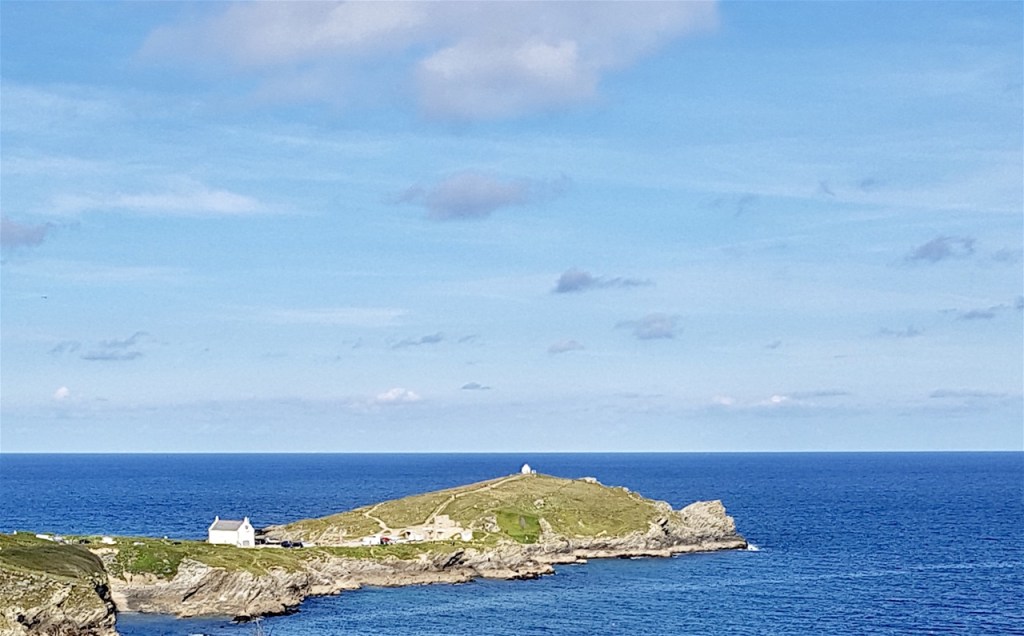
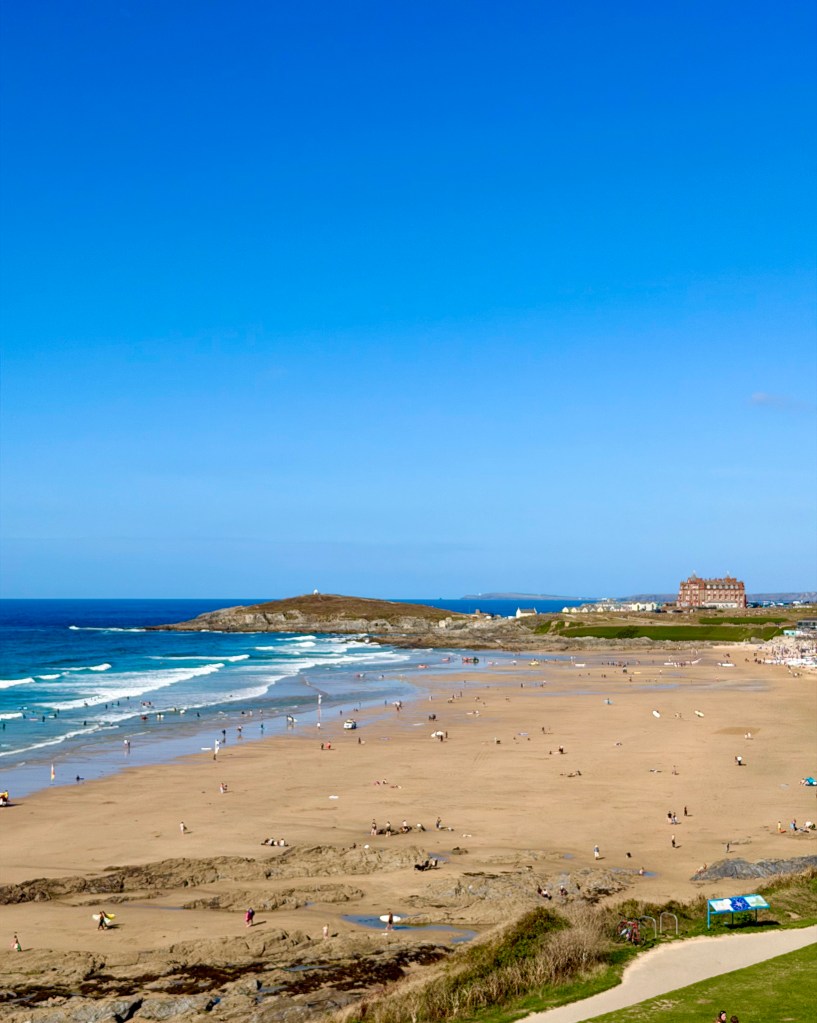
We’re based in Newquay, overlooking Fistral Beach. On our last visit here, in late September, we went for an early morning walk on Fistral Beach, not a very strenuous walk but glorious in the early morning with just a dozen or so surfers on the water.
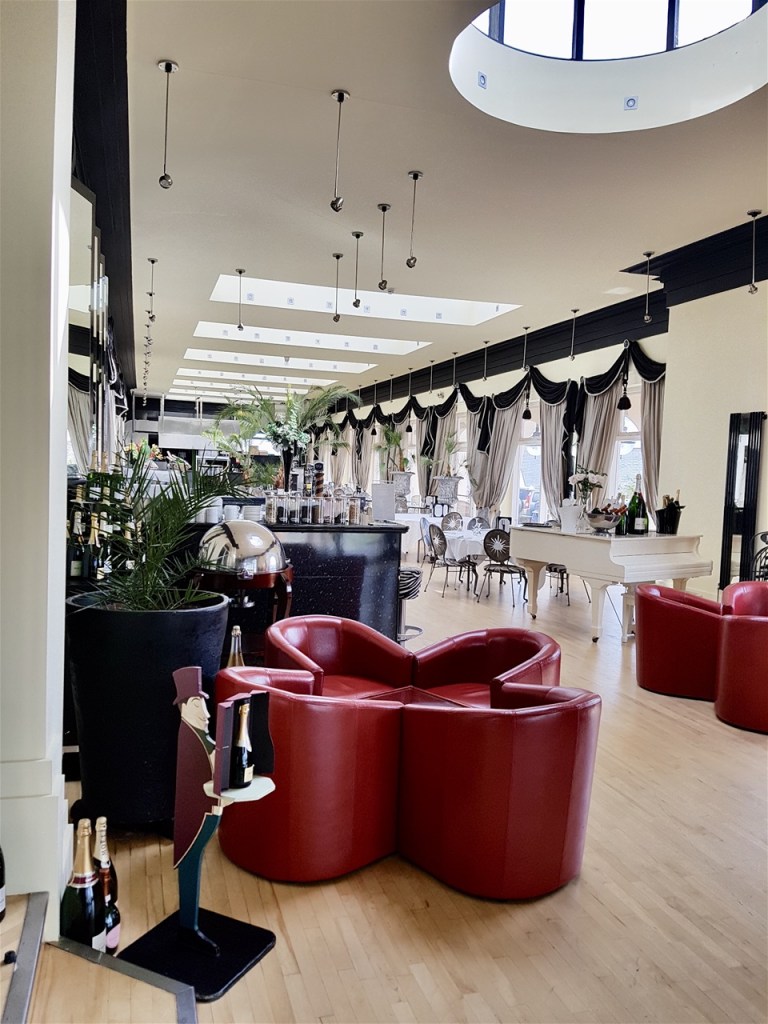
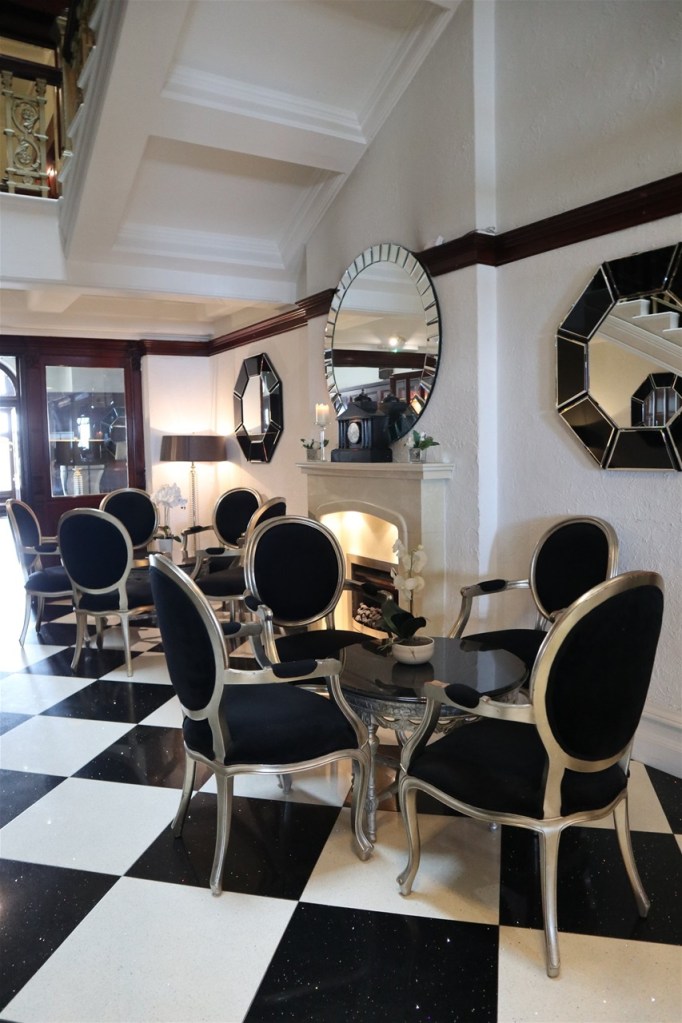
We intended to wander up to the Headland Hotel for a coffee, but on the spur of the moment decided to go to the Atlantic Hotel instead. They’re both Newquay icons and while we prefer the rambling splendour of the Headland it’s never a bad thing to act on a whim.
The Atlantic it would be then. The uniformed man guarding the revolving doors welcomed us inside and then asked if we were here for the party. Marigold was looking lovely as usual, but I had dressed for a wander along a beach and was looking fairly dishevelled even by my lamentably low standards.
We said we weren’t here for a party and he grinned and waved a hand at the selection of high end limousines in the car park. ‘Wall to wall toffs today,’ he confided, ‘there’s a party getting set up to celebrate the end of the season but I reckon they’re a bit premature. We’re chock a block for October and my mate at the Headland Hotel says they’re the same. Looks like we’re stuck with the emmets for even longer this year.’
We walked into the lobby, both a tad pleased to be so readily taken for Cornish ‘natives’ and immediately saw what the planned party was all about. There were tables being laid, flowers placed in vases and a group of women dressed up to the nines bustling about with place cards.
‘Hello,’ one woman called out and we turned to see the owner of an artisan bakery we occasionally chat to when our paths cross. We went over to say hello and received news of a celebratory party to mark the official end of summer.
‘Last day in September,’ our informant said, ‘all the beaches revert to being dog friendly, not just some of them, and the visitors vanish until Easter.’
Behind her the dining room was packed with hotel guests and we’d just been told of buoyant bookings for the following month, but we’re far too well mannered to argue the point.
‘Newquay becomes our town again. We can park our cars, get a table in a restaurant, walk on the beaches, isn’t it marvellous?’
We agreed it was indeed marvellous and went in search of a restorative coffee. Our waiter wasn’t slow in putting an alternative view. ‘My last shift,’ he muttered, ‘only told me yesterday there’d be nothing doing here after today. I’m summer relief, see, not permanent, but most of them will be off at the end of next month as well.’
‘What will you do?’ Marigold asked. She’s a worrier, usually on behalf of other people.
‘Dunno. Might have to go back on the dole. There’s loads of us being laid off and every other place will be the same I reckon.’
There’s the conundrum. Locals begrudge the influx of visitors but without them, what’s left? Very little I fear.
The beach is getting busier we see from our vantage point as we sip our coffee. Fistral Beach has become synonymous with surfing and now looks very different to the stark beauty of the bay we first glimpsed in the 1960s when there was a beach, the Headland Hotel at the far end and behind the beach just sand dunes and the Newquay Golf Club.
Now there are surf schools, restaurants and all manner of stuff, but the beach and the waves are what everyone comes here for.
I learnt recently the name ‘Fistral is derived from the Cornish word meaning foul water. The sea here is almost translucent blue so it’s obviously not a reference to water quality, but to the ferocity of the breaking waves making it an unsuitable landing site. A sailors’ misery is a surfers’ delight.
Almost every day here is good surfing conditions and there’s also a ‘secret’ breaking point called the Cribbar where under certain conditions of wind and tide 30 foot waves can occur. It’s every surfers dream to rock up on the beach at dawn and find The Cribbar in full spate.
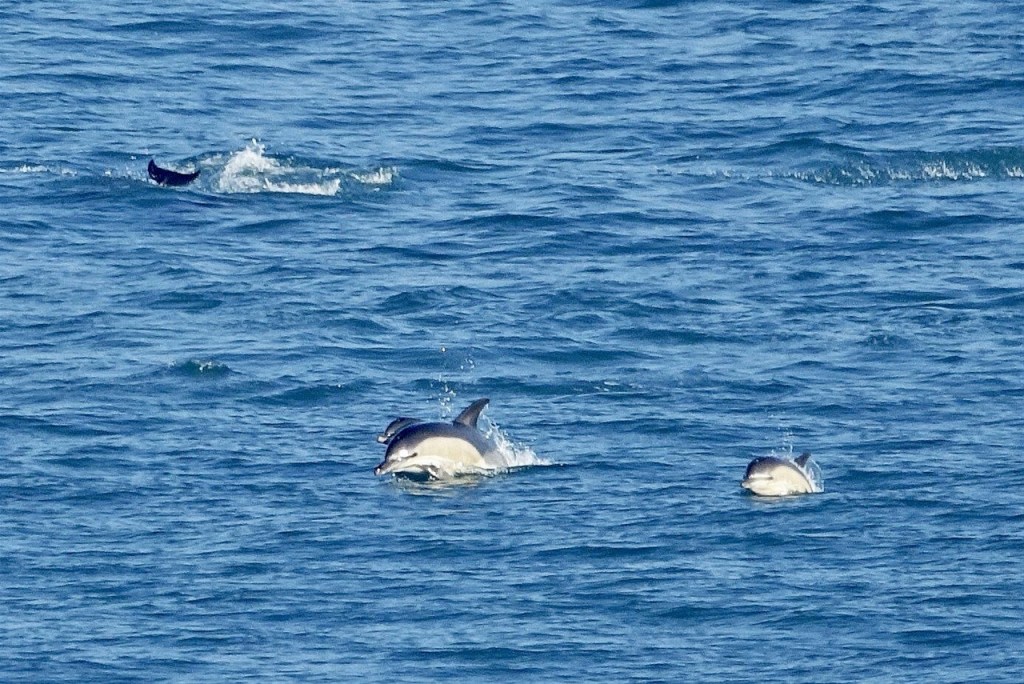
A while ago we did a road trip through the Western USA and one of the highlights for me was visiting Huntington Beach. On entering Huntington Beach a big road sign proclaims this is ‘Surf City, USA.’
Huntington is surfing. Almost every shop sells surfing gear and the cafes and restaurants are surfing themed as well. There’s a statue of Duke Kahanamoku there too. He’s the man credited with introducing the sport of surfing to California and also, later, to Sydney, Australia. Originally from Hawaii, he was a great swimmer, winning gold medals at three Olympic Games, eventually beaten by no less than Johnny Weissmuller who became the first Tarzan.
In Britain the first person to surf the waves was of far less exotic origins. He was a dentist from Nuneaton named Jimmy Dix who wrote to Duke Kahanamoku asking for details of how to build a surfboard. Instead of a specification Duke sent back a 13-foot Tom Blake surfboard as a gift! Jimmy Dix strapped the huge board to the roof of his car and drove down to Newquay to try it out.
I imagine he received many baffled looks, but when three Aussie lifeguards arrived in Newquay with their fibreglass performance surfboards, they changed the face of the town forever and the Cornish surfing craze was born.
Three local men set up a surfboard manufacturing company, Bilbo Surfboards, one of them being a man named Doug Wilson, formerly a beach photographer.
At this point our association with Cornwall began. In early 1969 Marigold and I arrived in Newquay in a decrepit Austin A35 Van containing all our worldly goods and a leaky ridge tent. Marigold worked for Doug Wilson at the Bilbo Surf Boutique and I abandoned academia to work as a ‘bouncer’ at The Sailors Arms directly opposite the boutique and in the day time delivered custom built surf boards to customers all across Cornwall and Devon. Doug, our ‘boss’ at Bilbo, drove a bright yellow Lotus Europa. It was the noisiest car in town, but the girls in the shop used to like that as it gave advance warning of his arrival so they could look busy when he entered. He gave me a copy of his book “Learn to Surf,” published in 1967 by The European Surfing Company, which was sold with all new Bilbo boards to help newcomers to the sport – complete with a glossary of surfing terms. I hung on to this for many years, hoping it would become valuable, but I can’t find it now.
Back then the road which leads down to Great Western Beach was known as The Slope and the bottom of The Slope was the meeting point for a cosmopolitan group of surfers. When the waves were good they all surfed, on dull days they still came to talk about great waves of the world. We attended a few surfing film evenings at local village halls and I noticed many of the Californian surfers wore choker style bead necklaces. On a visit to St Ives we came across a shop called Trade Winds that sold African trinkets. I bought most of their stock of bead table mats, made from threaded beads of many colours. A sports shop provided fishing line and, with a larger bead to form a fastener we set up a craft workshop.
In a fairly short time we were able to knock out bead necklaces of any pattern the customer may choose and I sold them to punters at the Sailor’s Arms. This became the ‘craze of the summer’ and we had to outsource manufacture to keep up with demand. The local newspaper, followed by The Daily Express, came down to interview us for an article. Alan Sugar or Richard Branson would have seen this as the first stage to building a trading empire. We just carried on having a laugh and enjoying life.
My ‘doorman’ evening shift at the Sailor’s Arms wasn’t demanding, albeit it was fairly dangerous at times. Most troublesome customers could be calmed and/or evicted from the premises by friendly persuasion, but not always. The worst time was a two week period when it seemed half of Glasgow came to Newquay for a fight related holiday and the jagged edges of broken beer bottles were being waved about.
We used to say ‘bouncer’ not ‘doorman’ in those days, back when rodent control operatives were still rat catchers. I hear the term du jour is door supervisor now, but whatever the nomenclature the role is that of a ‘chucker out of undesirables.’
Being occasionally undesirable myself at the time it was a classic case of poacher turned gamekeeper. In many ways it was a dream job. I was usually able to persuade unruly or especially truculent customers to go outside for a breath of air without resorting to the violent laying on of hands and almost everyone was in happy, holiday mood.
I was provided with liquid refreshment ‘on tap’ as required and a staff meal, usually either pie and mash or the latest craze in the pub trade, a Ploughmans’ Lunch. If you managed to locate a ploughman in Newquay – never easy – he’d surely decline the offer of a chunk of hard cheese, some person’s misjudged version of half a ‘French Stick’ and a dollop of Branson pickle where I suspected (with good reason) some of the dark lumpy bits were actually dead flies trapped in the glutinous mixture. That French stick may have had the correct shape, but there ended any resemblance to the genuine Continental article, but we weren’t to know that back then.
Even so, this was the 1960s, the British at that time were an ill informed bunch at the best of times, ever eager to pounce on the latest offerings dreamed up by advertising men in smoke filled rooms.
Not that much has changed in the interim, apart from smokers becoming workplace pariahs.
The Sailors Arms was the epicentre of Newquay nightlife, seemingly it still is, and the bar staff worked flat out every night to satisfy the throngs of thirsty customers. I went in today and didn’t recognise the place. The beer garden at the back is now an area of decking with tables and chairs. Very different from when it was standing room only and movement was virtually impossible.
I spoke to a customer propping up the bar. He looked like the archetypal life-long surfer with a deeply lined sun damaged face and long, straggly salt bleached hair. When I told him I had worked here in 1969 he whistled. ‘I wasn’t even born until 1990,’ he said. It was my turn to look astonished but I think I masked it well enough. He looked older than me! Obviously had a hard life. He said The Sailor’s was still the place to be seen in Newquay and even now the queues to get in on weekend evenings were at least 100 metres long. I could now accept the possibility of him being ‘only’ 36 as he’d described distance in metres, not yards.
In 1969 the bar staff were mostly Antipodean. Slaving away behind the bar at night and still having enough energy for the notorious, anarchic, nightly, lock-ins. As Morocco was going to be where we all planned to go at the end of the season the juke box played ‘Marrakech Express’ on repeat.
Marigold and I often think of those wild, carefree days and often the catalyst for memory is a song we associate with the Sailors’s Arms juke box, full volume and free play settings applied after hours. I can precisely date certain songs by their association with that jukebox. Honky Tonk Women from the Rolling Stones alternating with Get Back from The Beatles. Elvis offering up In the Ghetto and so many more. Give Peace a Chance, Dancing in the Street, Pinball Wizard, Lily the Pink, they were on every day, every night with Je T’aime Moi non Plus by Serge Gainsbourg and Jane Birkin always available as a slow dance mood enhancer for the bar staff who had ‘pulled.’
Melting Pot by Blue Mink and Two Little Boys by Rolf Harris were on that jukebox too. Neither would get played on the BBC these days.
In the day time the bar staff went surfing. Our best friends were Aussies and Kiwis, following the waves around the world. It was a special era and set us irretrievably on our quest to see and do as much as possible in the time allotted to us. I love travelling, but without Marigold to share the experience, it wouldn’t be the same.
‘Wish I could do what you pair do, just swan off whenever you feel like it, seeing different places. I’d love to do that,’ a friend said to us recently.
‘Why don’t you then?’ Marigold, straight to the point.
A shrug of the shoulders, ‘Oh, I will, one of these days.’
I’m not so sure she will. Our friend is far more of a noun, an abstract noun at that, not a verb, a doing word. Marigold and I, we’re verbs. We do things. Why harbour regrets for things you wish you’d done until your dying day? Why live your life in a conditional tense? ‘If only’ is a pretty awful mantra to live your life by.
Eudaimonia expresses the contented happy state of a traveller. That’s us then. A Berber friend in the High Atlas Mountains of Morocco once told me I was a musafir. I wasn’t too sure about that until he told me it was the Arabic word for traveller. That’ll do nicely.


Brilliant , love all the anecdotes.
LikeLiked by 1 person