
WARS OF THE ROSES.
G Says…
Red or white? Not wine, but roses. The Red Rose as the symbol of Lancashire; White Rose for Yorkshire. It sounds trivial, but, trust me it’s a serious business either side of the Pennines.
Yorkshire folk and Lancashire folk don’t get on. It’s a fact. A power struggle, popularly known as the Wars of the Roses, began as a series of squabbles between two factions of the same family, the Plantagenets, and escalated into civil war between the Houses of Lancaster and York to settle the right to the English throne. The war was only ended in 1485 at the Battle of Bosworth Field when Henry Tudor, soon to become Henry the Seventh defeated Richard the Third.
1485 was a long time ago, but old rivalries persist to this day. As a ‘foreigner,’ technically, although still a proud son of the North, I can see differences. Yorkshire is much, much bigger for a start and Yorkies are not reticent about mentioning this, Yorkshire people tend to be taciturn and, let’s face it, pretty blunt, while Lancashire residents are often garrulous and can talk the hind legs off a donkey.
I’m comfortable with all of it. They’re all good Northern stock, well worth the highly prized ‘salt of the earth’ description.
Our Mystery Tour of the Northern Outposts continues. It’s only a mystery to us as we are following our tried and tested regime of going where the mood takes us. Many of our most spectacular experiences came about by taking a ‘road less travelled,’ to paraphrase Robert Frost. Unkindly, others have often remarked, ‘you get lost a lot.’
Asking for directions from strangers doesn’t come easily to me. In any case the system is massively flawed in practise. I’m ‘hard of hearing,’ which sounds kinder than ‘deaf as a post’ and unwilling to suffer the awkwardness of asking for words to be repeated I fall back on a method whereby I smile in a fatuous manner and keep on nodding despite not having understood one iota of what was said to me.
Marigold is even worse as she also nods obligingly, gives fulsome thanks to the stranger and allows them to go on their way.
‘What did they say?’ I ask. Marigold usually replies, ‘I wasn’t really listening, I thought you were.’
In the US, it became even more difficult as kind people often gave us directions including compass points as reference. Marigold declared at one point, ‘it’s no use telling me to go East, where’s East?’
Anyway, Marigold and I possess sang-froid by the bucket-full, we aren’t bothered by such trivial matters as whereabouts on the globe we happen to find ourselves at any specific time, so one person’s idea of getting lost is our concept of freedom. To boldly go’
We left York with a specific destination in mind and ended up in Knaresborough instead, many miles away. So what, we like it there. In fact, Knaresborough is one of our favourite towns, it has so much going for it. We first visited well over 40 years ago and look forward to a return trip every single time. It’s an intricate warren of medieval streets and stone staircases that weave their way up and down the hill. The town centre is perched high up on the cliffs above the River Nidd and the railway viaduct across the Nidd Gorge is a spectacular example of Victorian engineering.
We once spent two weeks in a quaint little cottage in Nidderdale – it was in my early ‘writing’ days and I was hoping to find a peaceful, relaxed haven in which I could meet a fast approaching deadline. No chance. Nidderdale, in fact the whole of the Yorkshire Dales offered far too many distractions.
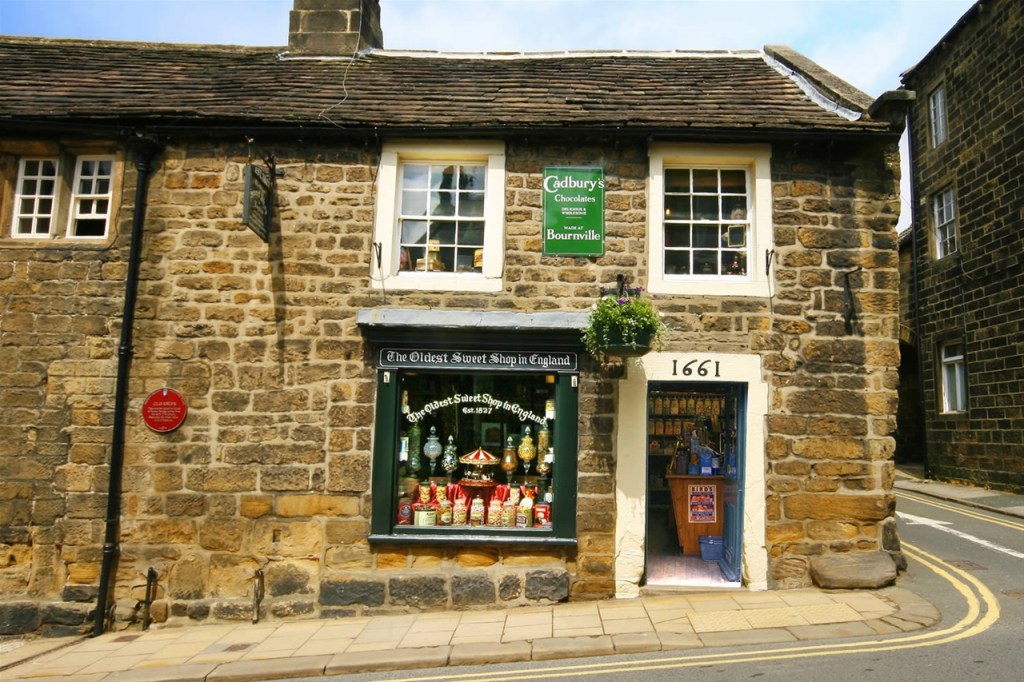
That cottage was just outside Pateley Bridge and we both remembered the pies in a butcher’s window and the Oldest Sweet Shop in England, both in the Main Street. It was an early introduction to Yorkshire attitudes. We had remarked on the large meat pies in a window display, only for a complete stranger to amend our description of ‘large’ to ‘massive.’
‘You’ll not find a bigger pie anywhere,’ the man insisted. ‘Biggest in the world, I reckon.’ Okay, we thought, not having ever really considered rating meat pies by size before, but the knowledgeable local wasn’t finished with us yet.
‘That sweet shop up the road,’ he added, nodding at the shop where a sign boasted of being the oldest sweet shop in England. ‘Oldest in the world, is that,’ he told us. ‘Never mind England, it’s the oldest in the world.’
That’s typical Yorkshire; it’s England’s largest county, by some distance, and Yorkshire folk, like Texans, are rarely accused of reticence.
We were reminded of that earlier visit to the area on arrival in Knaresborough which is the home of Ye Oldest Chymist Shoppe ‘ not a typo – the oldest chemist shop in England.
Well, of course it is!
Records reveal John Beckwith was dispensing medicines in the shop in 1720, but this use of the premises may actually date from much earlier because the building is over 200 years older and contained “dispensatories and herbals” from the seventeenth century. I very much doubt any branch of Boots the Chemist was ever described as a ‘Chymist Shoppe,’ but of course they had the misfortune to have originated in Nottinghamshire, not Yorkshire.
The River Nidd splits the town into two. One side of the valley climbs up to the town centre and the other is densely wooded. Tucked away in that woodland is Mother Shipton’s cave which has been open to the public since 1630 and in typical Yorkshire fashion is claimed to be England’s oldest tourist attraction.
We’re not fans of ‘tourist attractions’ ‘ but in this Covid era you would have to prebook anyway and we hadn’t which saved us 16. It is claimed Mother Shipton ‘ real name Ursula Sontheil – correctly prophesied many events including the Great Fire of London in 1666 and the defeat of the Spanish Armada. Ah, okay, that’s why it’s 8 each then.
There’s also a Petrifying Wellwhich has minerals capable of turning everyday items into stone in just a few months thanks to the process of calcification. We’re very well versed in calcification, there are several petrifying wells in Derbyshire, so we weren’t missing much.
A hermit named Robert Flower who miraculously healed the sick also lived in a cave nearby, but we didn’t bother to investigate further after a local woman told us it was ‘rubbish.’ They don’t mince words in Yorkshire. It saves time and trouble. I approve, but can’t bring myself to be habitually blunt and dogmatic. I really wish I wasn’t cursed with politeness.
The attractions on offer, so far, had been described as ‘rubbish.’ The ruined 12th century castle on top of the hill was another matter entirely. No need for made up tales of long ago there as the fortress has a rich history. The murderers of the Archbishop of Canterbury Thomas Becket spent time hiding within its walls during the winter of 1170-71, while Edward III and King John were known visitors and Richard II was imprisoned at the castle after losing the crown in 1399.
It was in use for more than 500 years and served as a key garrison during the English Civil War. However, it was largely destroyed in 1648 when parliament ordered for Royalist castles to be dismantled. Yorkshire thrift ensured that many buildings in the town were built using stone plundered from the castle.
We like castles and it seems we aren’t alone as there were many visitors strolling around the ruins. There are resident ravens, one of them was donated by the Tower of London ‘ ‘levelling-up’ in practise ‘ but of course we were not allowed inside on this occasion. Covid again. It’s a good place for a picnic on the grass with spectacular views down to the river, but it was a bit too crowded for us.
Coach trips are back in business though. One party had a guide who we overheard referencing Thomas Becket on several occasions. His lack of knowledge was staggering, but most of his group weren’t listening anyway, their mobile phones being far more interesting. Becket’s murderers hid away inside Knaresborough Castle for about a year. They were never arrested and neither did King Henry confiscate their lands, but Pope Alexander did excommunicate them. Seeking Papal forgiveness, the assassins travelled to Rome and were ordered by the Pope to serve as knights in the Holy Lands for a period of fourteen years as penance for their heinous crime.
I knew all this, along with quite a bit more, but the professional guide merely referred to ‘some very bad men who killed Thomas Becket and stayed here for a while.’ My sole reaction being an audible snort of derision prompted Marigold to say, ‘you’re becoming a lot more tolerant lately’ as we walked away.
The last time we were in Knaresborough I bought a top of the range ‘outward bound style’ coat in a charity shop and after paying for it left the shop without picking it up. I didn’t notice its absence until we were hundreds of miles away. Bitter memories. As we passed the shop Marigold hissed, ‘don’t you dare.’ I quickly assured her the idea of mentioning my abandoned purchase seven years ago had never crossed my mind.
North Face, extra large, navy blue with three zipped pockets, no it’s long forgotten, really.
School history lessons were often dull, but a few names stuck in memory. Turnip Townsend and Jethro Tull were significant figures of the Agricultural Revolution, but it was probably that remarkable man, Blind Jack of Knaresborough, I remembered best of all.
John Metcalf, more commonly known as Blind Jack of Knaresborough, was the first professional road builder to emerge during the Industrial Revolution. Born in 1717 in a thatched cottage opposite Knaresborough Castle he designed and helped to build around 180 miles of road across Yorkshire, Lancashire and Derbyshire. Many of his routes still survive, including the A59 on which we travelled today.
He was blind from the age of six following a smallpox infection. At age 15, Jack became the in-house fiddler at the Queen’s Head in Harrogate, and also became a guide to visitors in the local area. A blind guide? It’s not exactly common, is it?
We once popped into the Queens Head, but failed to spot a resident fiddler although many of the customers looked a bit shifty! Blind Jack eloped with Dolly Benson, the daughter of the landlord of the Royal Oak in Knaresborough, said to be the prettiest girl in the district. Sad really, that he was unable to fully appreciate his good fortune.
In 1745 Blind Jack joined the ‘Yorkshire Blues’, a 64-man militia raised in the district by Captain Thornton to fight Bonnie Prince Charlie and was present at the Battle of Culloden, which saw the decisive defeat of the Jacobite rising by the Duke of Cumberland. Town guide, soldier, fiddle player, not bad for a totally blind man.
He went on to run a stagecoach company running between York and Knaresborough and even a blind man couldn’t have failed to notice the appalling condition of the road. He obtained a contract to build a three-mile stretch of road between Ferrensby and Minskip with his gang of workmen and finally found his calling.
After all that road building, at the age of 78, Blind Jack walked from Spofforth to York – that’s 35 miles – to dictate his life story to a publisher, who printed the biography in 1795. E. & R. Pick’s The Life of John Metcalf, Commonly Called Blind Jack of Knaresborough.
I read the book at the age of 14 or 15 and have only recently tracked down a replacement copy in a dingy second hand bookshop. It details Blind Jack’s road building feats and also his exploits in hunting, card-playing, cock-fighting, bridge construction and sundry ‘other undertakings’.
Upon his death aged 93, Blind Jack left behind 4 daughters, 20 grandchildren and a phenomenal 90 great and great-great grandchildren.
We sat on a bench alongside a Blind Jack figure outside (relatively new in a town full of really old pubs) Blind Jack’s pub. The bronze statue, by Barbara Asquith, has been there since 2008, the cost of £30,000 being raised by Knaresborough residents.

The classic view of Knaresborough

There’s a castle too. Well, part of one.
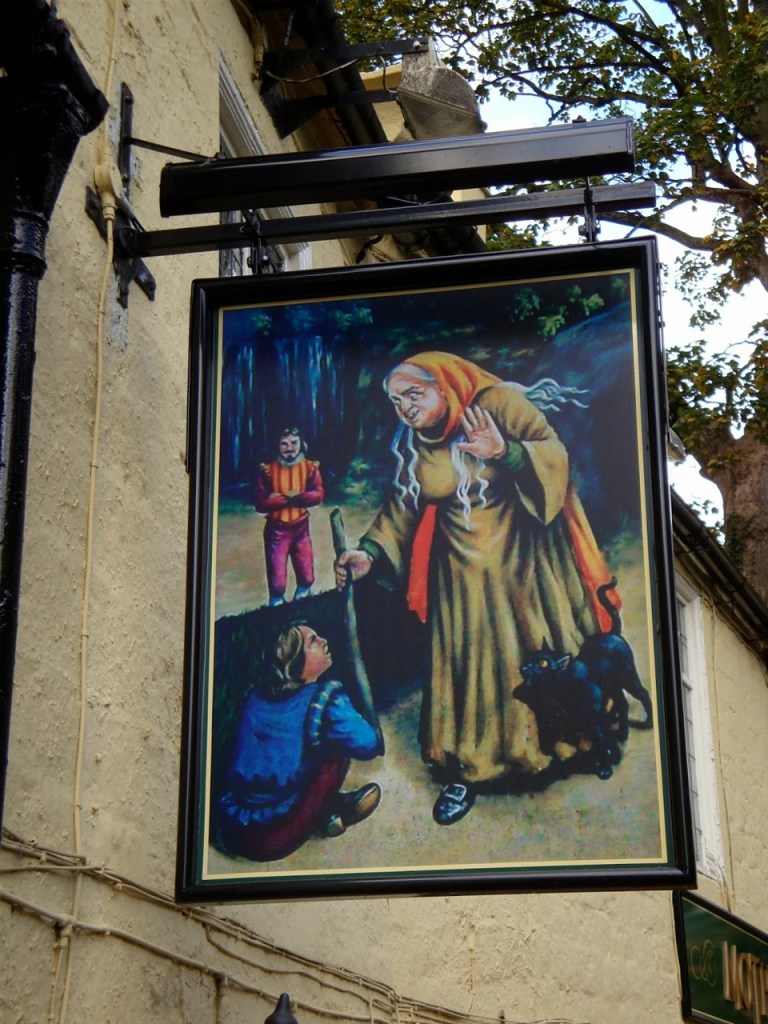
Mother Shipton. Possibly not on one of her good days.
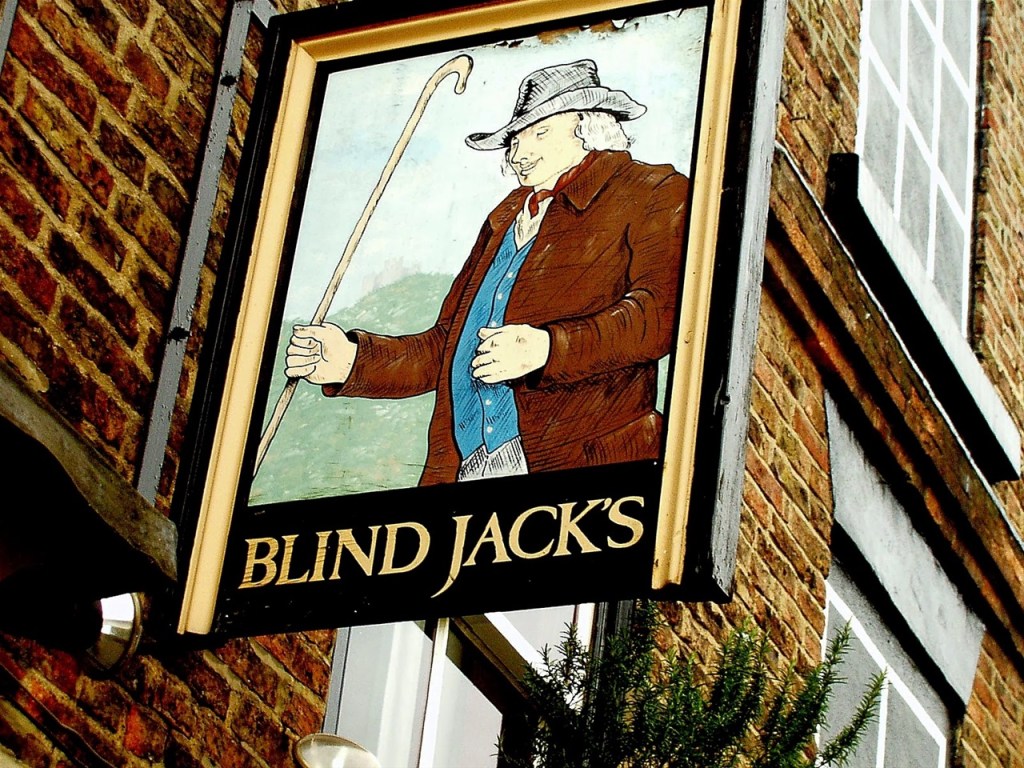
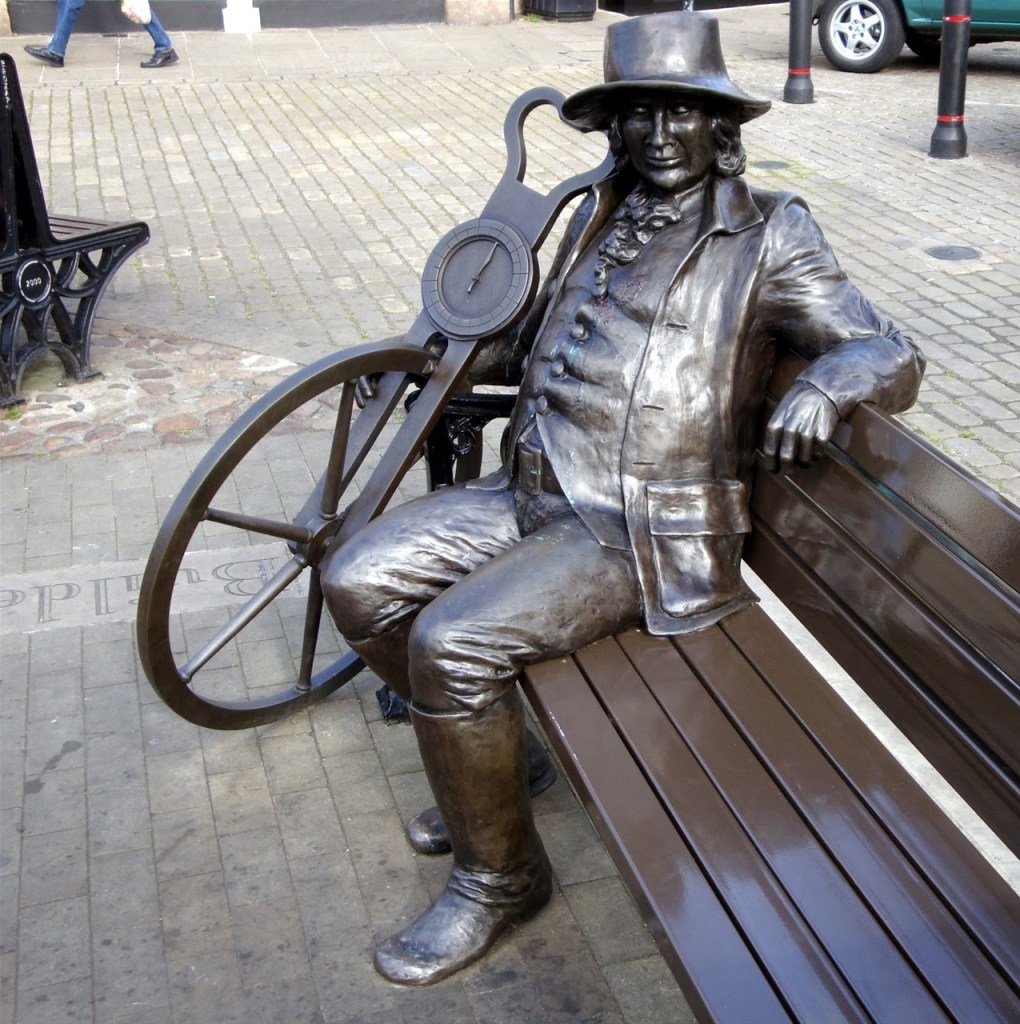
The man himself. Blind Jack. I suspect I may have mentioned him.
 Marigold on Tour