
G Says…
June 2025. We travelled to France via Eurotunnel, so much quicker and easier than a ferry. Or so we thought. After boarding on time we dutifully opened our side windows to half way, applied the handbrake and put the car in ‘Park’. The young woman who walked the length of the train admonishing miscreants passed us by with a smile. So far so good.
An hour later nothing had changed, we still hadn’t moved. An unintelligible message over the tannoy was of no help. Eventually the young woman appeared telling us all as she passed that the train had developed a fault which she described as as ‘terminal’ and the man in the car behind us shouted out, ‘you mean it’s knackered?’ Being a well brought up young woman she just nodded and walked on.
We ate our sandwiches, intended as lunch, and after a further half hour the same woman came back to tell us we needed to ‘evacuate.’ We all drove off, formed a convey along a torturous route across three bridges and entered a different, much longer train. That one worked and after all the delay, plus adding an hour for the time difference, we arrived in France at lunchtime. Minus our sandwiches!
We pressed on and managed to get ourselves booked in at a hotel in Caen. Hotel accommodation is at a premium in Normandy due to the anniversary of the D-Day Landings. Our unreliable sat nav has hated me from the start and trying to reach a specific point, even when it was only half a mile away, when many of the streets of Caen were blocked off for roadworks drove us and tge sat nav to distraction. Eventually, I turned it off, relied on common sense and a sense of direction and found the hotel.
After unloading our ‘overnight’ bags in our room we went down to the lobby where there were several comfortable armchairs. ‘Peace at last,’said Marigold. A few moments later a man in his twenties wearing the clothes and demeanour of a middle aged man turned up and said, ‘I couldn’t help noticing you are English. What a relief. I have been here over a week and not found anyone to talk to.’
Putting aside the remarkable situation where he had only met French people, in a French hotel, in France, we found ourselves selected as ‘people to talk to.’ Now, we like people, we like talking to people, but this wasn’t one of those occasions. Of course, being cursed by politeness, we listened. Not chatted, just listened. Our new friend had driven from Calais, he described the route in great detail, and even though we had just done the identical trip we just listened and smiled occasionally to prove we were still alive.
‘Longest drive I ever did before last week was to Exeter, that’s quite a long way though, isn’t it?’ Well, lacking any knowledge of his starting point – we didn’t ask- we merely nodded agreement. He went on to explain he had travelled into Europe before, but ‘only on a coach, with mother, to Lithuania.’ He’d come to Normandy to celebrate the life of his grandfather, who he had never met but ‘assumed’ he would have been involved in D-Day back in 1944. ‘Mother never talked about him so he is a closed book, really.’ Our talkative companion had attended a commemorative service, but hadn’t been impressed. ‘It was all in French so I didn’t understand any if it and when I was expecting Abide With Me, instead they wheeled out a fat opera singer who screeched at us for ages.’
After half an hour he invited to go with him ‘to the Buffalo Grill to eat a lot of meat.’ We were obliged to decline this offer.
People who come over to chat to us are part and parcel of our lives. I blame Marigold. She has a ‘talk to me’ face. Such are the risks involved in traveling.
The next day we arrived in Brittany, specifically in the Gulf of Morbihan. Mor-Bihan (meaning ‘little sea’) is the traditional Breton name of the Gulf of Morbihan stretching for many miles along the southern coast of Brittany and contains numerous islands, large and small, and captivatingly beautiful inlets and coves. The Gulf is a tidal basin created 2,000 years ago when the Atlantic Ocean overflowed into low-lying land through a gap in the coastline. Today we based ourselves in Vannes as we last visited this area about twenty years ago and Vannes was a highlight of that trip.
Vannes was founded by the Romans in 56BC as Darioritum after their victory over the Veneti. In the 5th century AD, the town was renamed Venetis and the original hilltop site was abandoned as a new town grew up inside fortifications. But it was the Middle Ages that shaped Vannes and it’s spectacular buildings.
There are 170 half timbered houses in Vannes – I didn’t count them – but back in the 15th century there were about nine hundred. Most of them are built with a design detail called corbelling, where the upper floors overhang the ground floor.
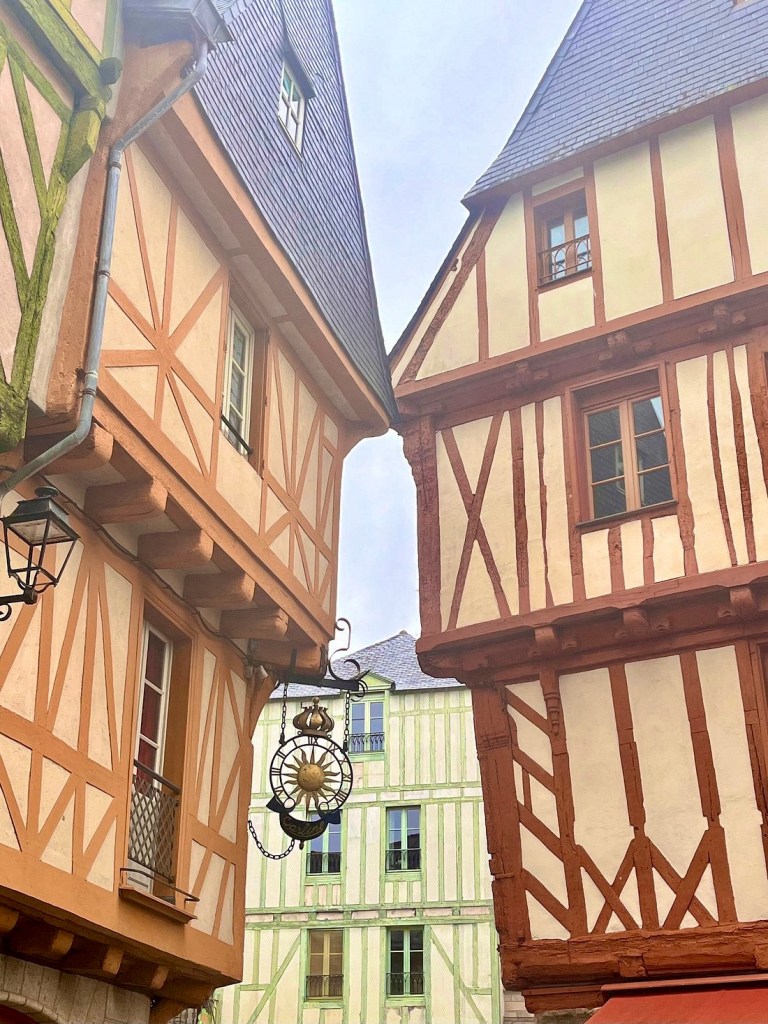
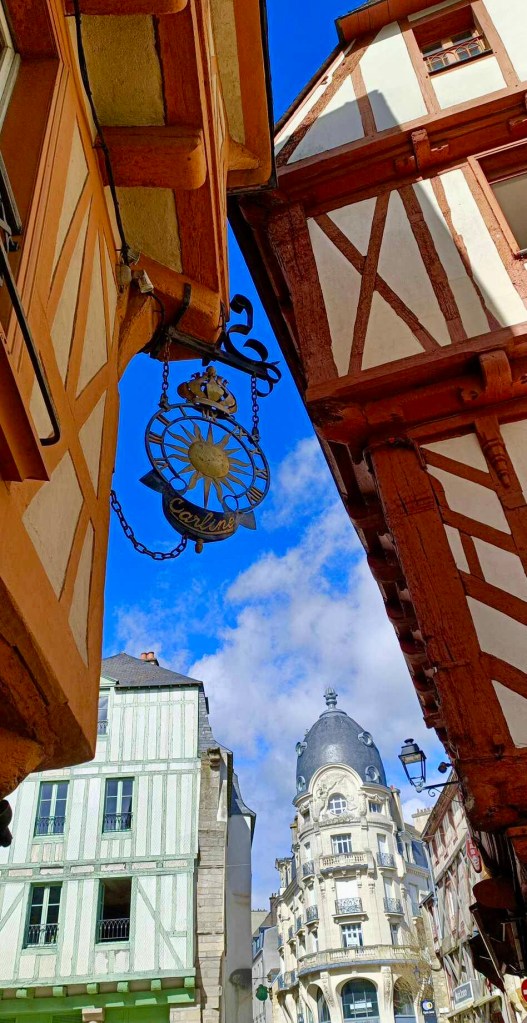
This is typical of the Middle Ages, we saw many similarly styled buildings in York recently, and allows the pathway between buildings to be wider, but afar more prosaic reason could be that only the area of the ground floor was subject to tax. The close proximity of many upper levels – near enough to climb from one house to another- also means the danger of fire spreading from building to building is greatly increased. A significant factor in the vast destruction caused by the Great Fire of London.


On the corner of Bueneureux-Pierre-Rene-Rogue Street and (much easier to spell) Noe Street are two granite heads, as must be the case every day there were dozens of other people taking photographs of them today. A talkative local told me there was a family named Venne living in this area long ago and Monsieur Venne, apparently, had these busts commissioned to honour his wife and himself. Over the centuries the ‘Vennes’ became transposed to ‘Vannes’ and became the name of the town. The romantic part of me hopes it’s a true story.

Erected on the foundations of a fortified Roman town, the history of Vannes is revealed in its architecture, especially the settlement that lies behind its encircling walls. Dominated by the magnificent Cathédrale de St Pierre, the walled town contains numerous wood-beamed houses from the 15th century.
In England, timber-frame Tudor houses, including more modern ‘Tudor style’ are a common sight, but are usually ‘black and white’, but in Vannes the styling is much more extravagant with beams painted various tasteful shades red, orange, yellow, green, even a vivid blue.
In French, they’re known as maison à colombages – half-timbered houses – and date from as early as the Middle Ages to the 17th century. Some of the finer examples were constructed when the Breton Parliament, exiled from Rennes, was based here in. The 17th century.
Probably the best place to view ancient these houses is Place Henri IV, especially the point where two half-timber buildings appear close enough to ‘kiss’ each other, with the Cathedral spire in the background.

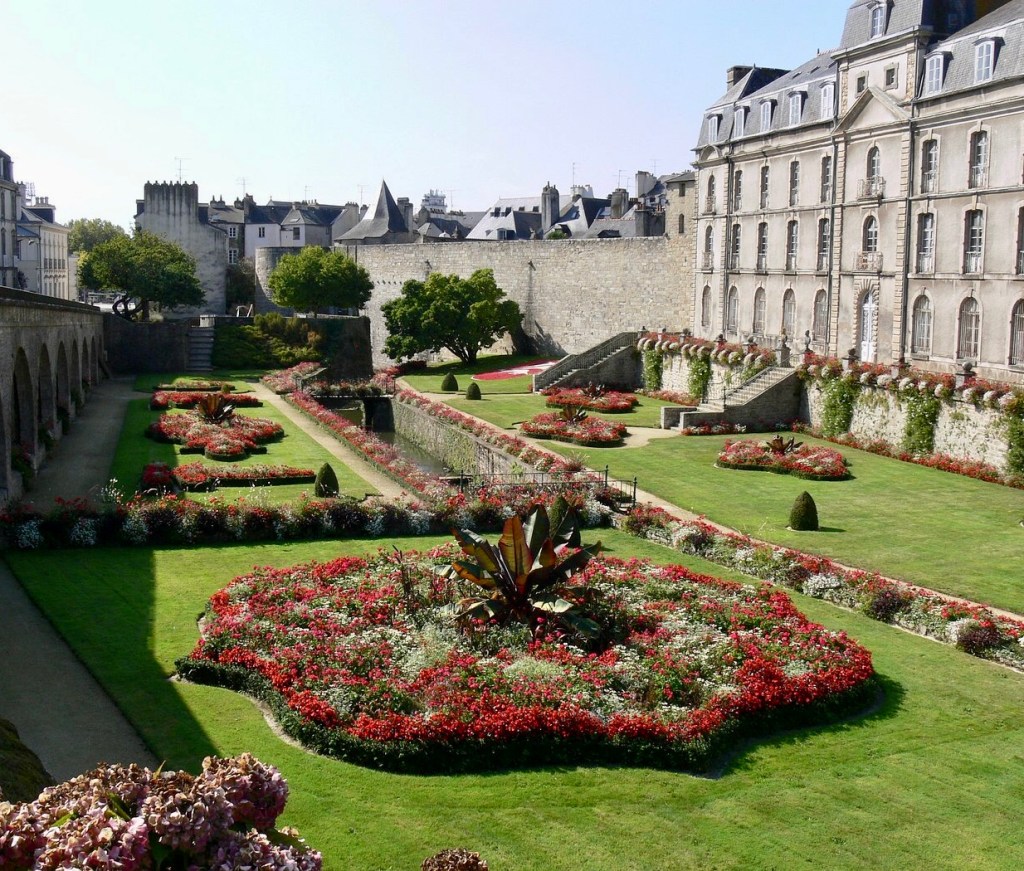
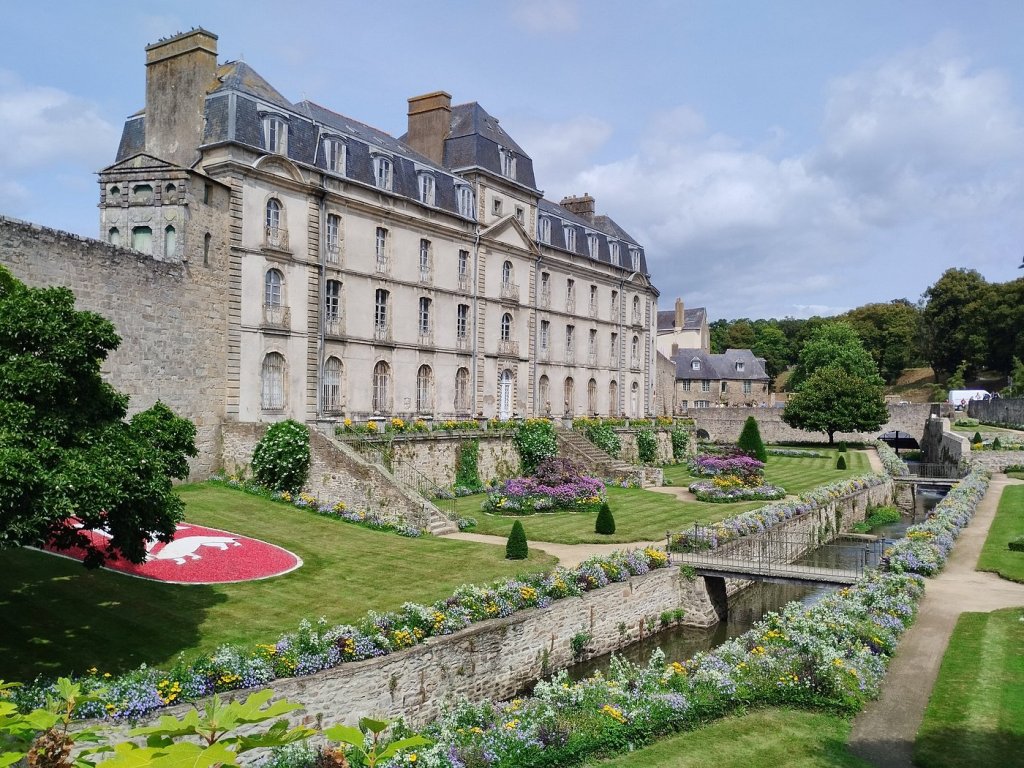
As for the ramparts surrounding Vannes, they aren’t as accessible as some, Chester and York being obvious examples, but we did manage a short rampart walk to look over the visually stunning Jardin des Remparts.
These gardens, designed and laid out in typically French style, are found between the ramparts, the watchtowers and the river Marle flowing towards the old washhouses (lavoirs ).
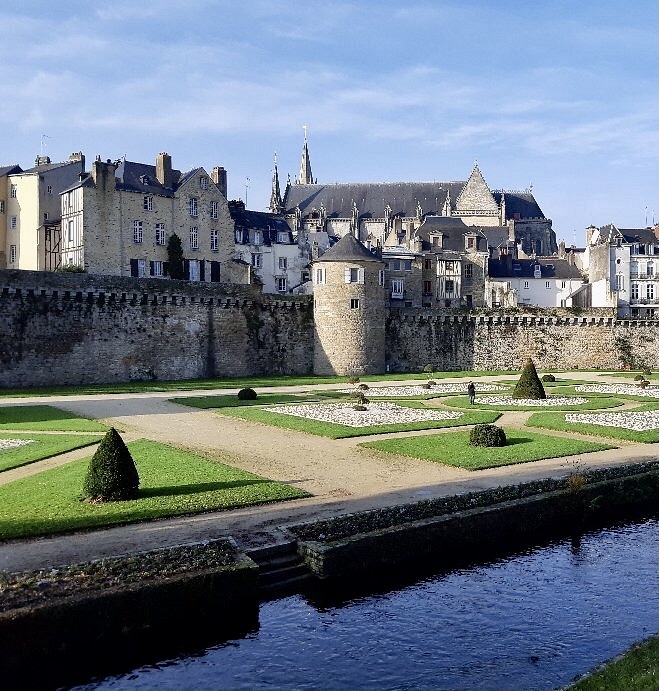
Just along from the gardens, we found the stunning Chateau de l’Hermine built into the ramparts.
The original Chateau de l’Hermine was built by the Duke of Brittany, but after being partially destroyed in battle, its stones were used to repair the ramparts and build the port of Vannes. The present chateau was built in the 18th century on the same site as the Duke’s castle. It passed into State ownership following an owner’s profligacy and eventual bankruptcy, and it is now intended to be the permanent home of a Fine Arts Museum.
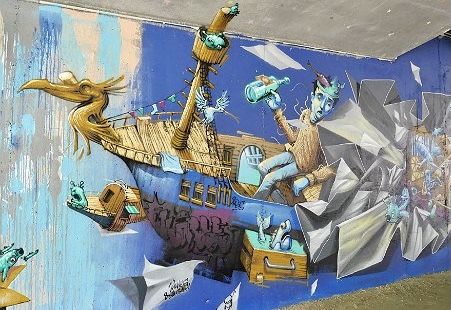
There’s even street art, well hidden away.


We don’t spend all day traipsing cobbled streets. We eat out occasionally.
 Marigold on Tour