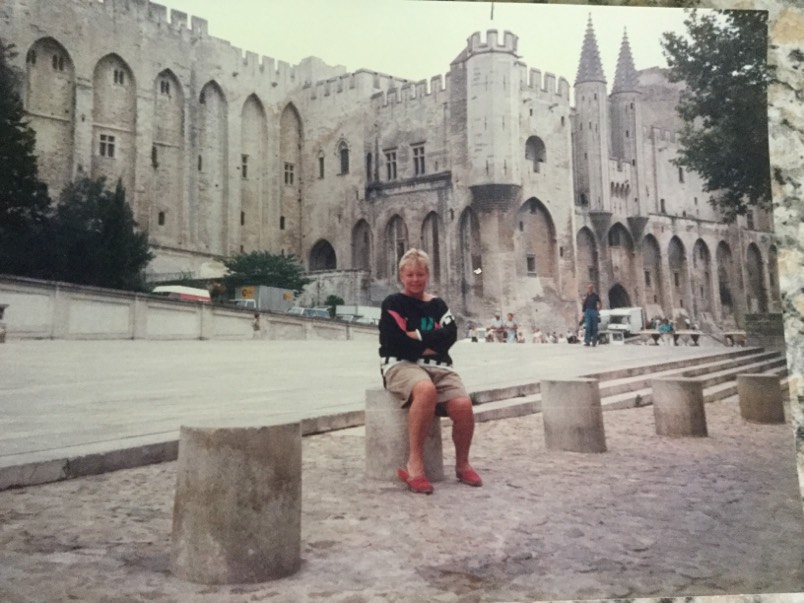
Marigold in Avignon. Hint, it’s not a recent photo.
Marigold Says…
I have just read that some bloke from the south when visiting a relative in the north who was eating a banana sandwich commented ‘they eat funny food in the north’. How very dare he? Banana sandwiches are a divine food and along with another favourite of ours, sliced potato sandwiches, a mainstay for journeys as they don’t go off and keep you full.
You couldn’t prepare an avocado and prawn buttie for a journey on a hot day. If you have sliced buttered bread you can squash a banana in it and hey presto, no cutlery needed and instant food wherever you are.
Pies are another gorgeous northern delight. Go to Yorkshire or Lancashire, the home of fabulous pies. I would love a job as a pie tester. There are the signs of weird concoctions creeping in even oop North but let’s hope it is short lived.
We’re just about ready to head back to England now. It’s been a brilliant holiday in sunny France, but not without a few problems. We’re not fussy people, but a couple of the hotels weren’t very good at all and the two apartments we picked were pretty awful. Our own fault I suppose.
At least we didn’t have to cope with any Turkish style toilets, the ones where it’s just a hole in the ground and there’s no toilet paper just a sponge on a stick. We have had lots of those, especially in Morocco and Turkey. I don’t think I can squat down any more and usually end up peeing on my feet. I need aiming practise.
Our last rented apartment was a complete revelation. It boasted of a kitchen, bathroom, bedroom, lounge and large garden in their advert so we said that sounds perfect. We entered a tiny hallway and in front of it was a curtain covering no more than a large cupboard space with a double bed pushed right up to the far wall. In order for G to get out he would have to climb over me.
Anyway, enough about that. In the bathroom you had to circumnavigate the toilet to get into the shower. The sink was no more than a caravan size. Kitchen was a double sink and next to it two electric hob plates. Absolutely no worktop. Inside a cupboard with a wonky door was a microwave and a kettle. Hoorah. I decided immediately no cooking would be done there so we lived off the local Boulangerie food which was great.
The garden had no fence between us and next door where an elderly couple were working on the fence, the owner of ours kept ringing up saying it will offer privacy by tomorrow. Tomorrow came, still no fence just a washing line of an elderly couples underwear.
The lawn we sat on was very cheap artificial grass, very lumpy in parts. The grass, didn’t need mowing but the weeds coming through did. We were sitting there one afternoon and something quite large was moving underneath, so we retreated to the small terrace.
So to bed. The only way we could make it function was to pull it out into the small hallway and park it next to the front door so we could both get in and out. It was ok until the free post arrived in the letter box next morning and landed on the bed. We were there for 3 nights and still no fence, but the postman was always on time, 6.30.
We made a decision of not to believe any blurb on apartments or photos. When we left there was still no fence but the bloomers on the line were quite dry.

Turkish style facilities. A good sense of balance is recommended
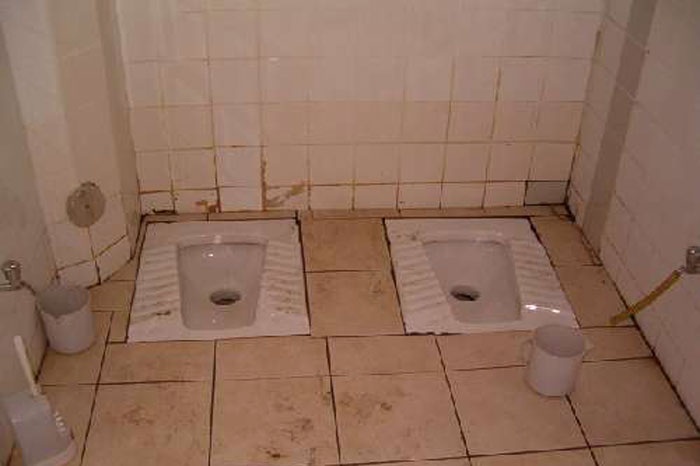
Here’s the version for those who like to chat. Marigold likes chatting, but there are limits!
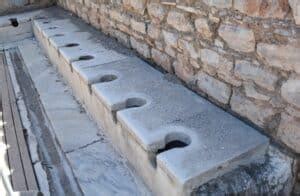
We saw these at Ephesus in Turkey. We weren’t tempted to try them out
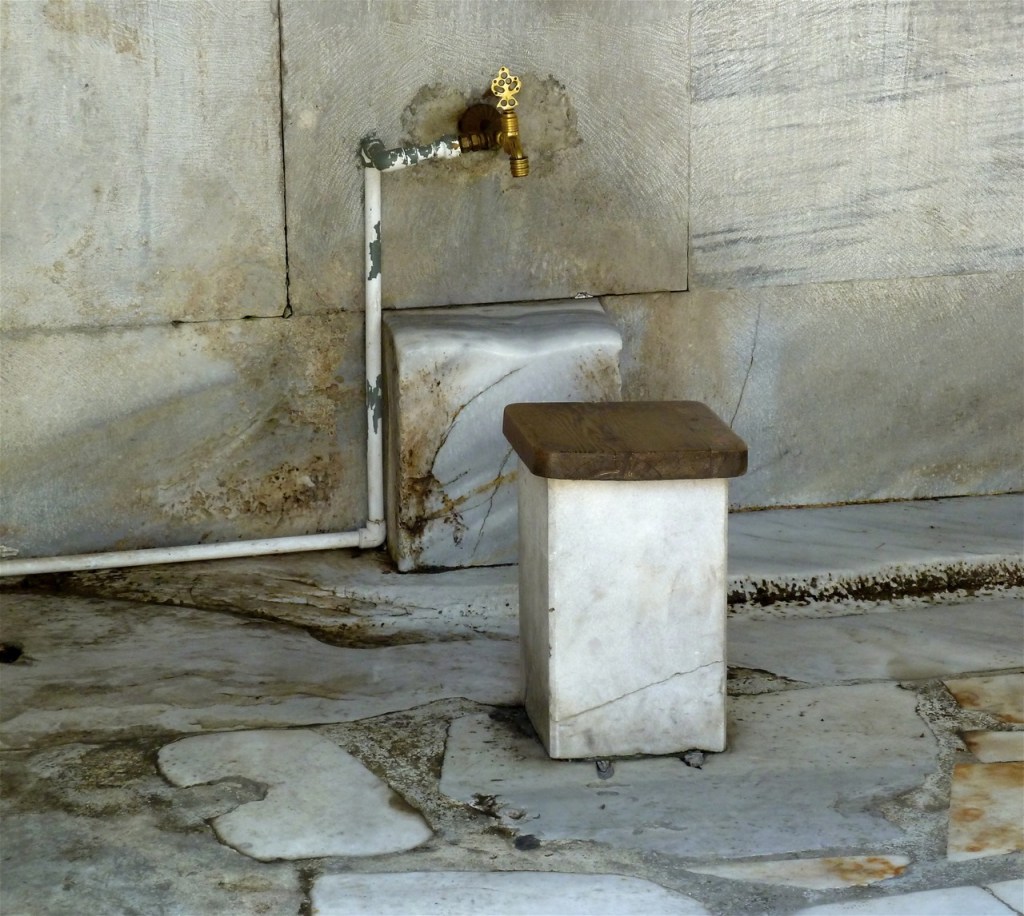
Some bathrooms we found on our travels were fairly basic
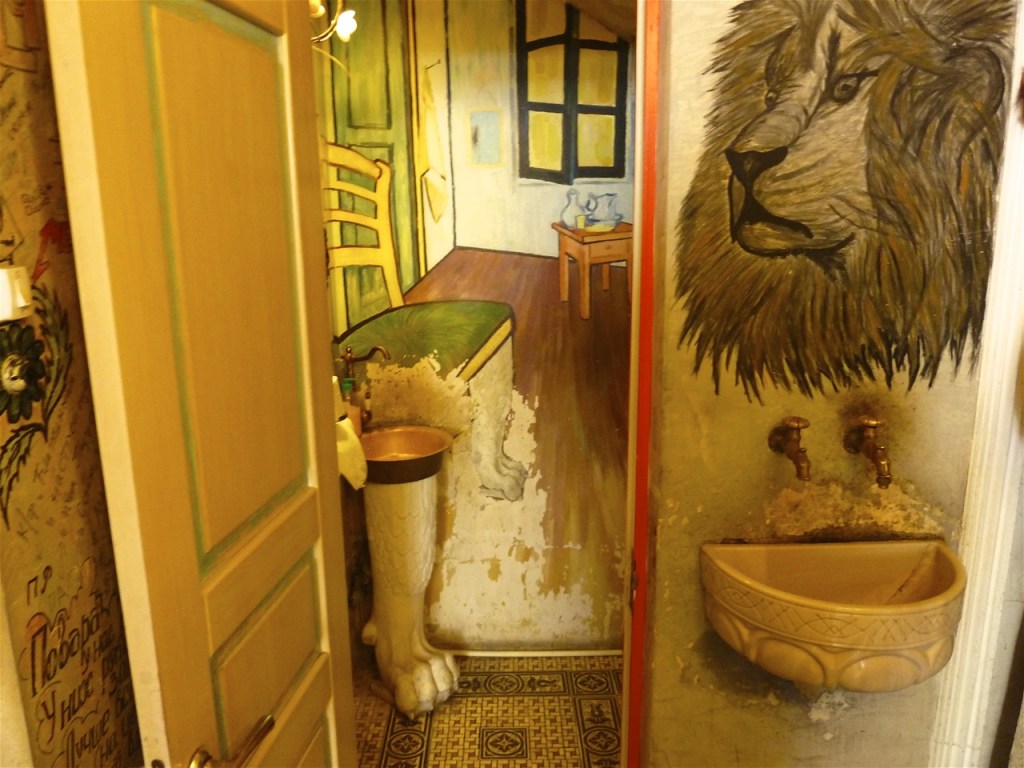
Others reached the heights of style and sophistication. In Ukraine.
G Says…
Marigold is getting very choosy about our staging post choices. I’d even go so far as to say picky. We managed very well for many years with virtually no space and no facilities as we toured Europe in a succession of camper vans, none of which could ever be described as luxurious. Utilitarian, maybe, but even that was being generous.
Hotels have advantages. A proper bed, a separate bathroom, no need to go outside in the middle of the night to have a pee, even a substandard hotel is paradise in comparison. Yes, I agree, the occasional hotel or rented apartment on this trip wasn’t up to expectations, but if we look back at some of the places we’ve spent the night in since we became car based instead of van based these recent ones in France were total luxury.
We weren’t overrun by cockroaches, there weren’t a succession of clients banging the door as they left the brothel next door, the toilet didn’t back flush, no bathroom sinks fell off the wall in the middle of the night and there weren’t twenty people having an all night party in the room next door. We have suffered every single one of those experiences in the past. Come on, Marigold, we weren’t even disturbed by a wild donkey or a camel poking its head through our window and noisily greeting us.# We have ‘enjoyed’ both of those as well.
#The camel was in Algeria, the ‘burro’ in Death Valley, USA.
When it comes to accommodation, it’s the really dreadful places that stay longest in the memory. A hotel in Morocco, on the outskirts of Fez, had a notice board pinned to the wall showing ‘endorsements’ of previous guests. The notice board had obviously been there for many years and most of the ‘testimonials’ were illegible, but Marigold did draw my attention to one scrawled message, written in English, which simply said, ‘this place is a s**t hole, but we liked the tortoises.’ We occasionally glance through Visitors Books at hotels, but have never previously seen that particular sentence.
The man taking bookings said there was only one room left. Yes, of course we booked in for the night. We agreed with the previous guest, in all respects. We hadn’t the benefit of en suite facilities and when Marigold nipped down the corridor in search of a bathroom she found a ‘squatting’ toilet which appeared to have been recently used by herds of incontinent warthogs.
She came back and reported, ‘it’s vile, I had to have a pee in the bath.’ When we returned in the middle of the night even that option was unavailable as the man who had been on the Reception desk was now asleep in the bath.
We didn’t risk breakfast, although it was included, but went up to look out at the city of Fez from the rooftop. The entire area was full of tortoises, at least a hundred, all sizes from babies to the very large and one was the size of a dustbin lid. It’s hard to describe tortoises as ‘friendly,’ but they seemed happy enough to be stroked by their English visitors.
‘Turkish style’ toilets are said to be more efficient ‘ physiologically speaking, but much less comfortable. Using one in the darkness of night with no lighting available can be treacherous and the alternatives to toilet paper are far less inviting. Even so, we’re no strangers to them and thus it was a surprise when Marigold was rather less than keen on the opportunity to make use of a double set, side by side, we came across in the Asian section of Istanbul.
Driving over the bridge spanning the Bosporus from Europe to Asia took only a few minutes, but twenty miles further on we found ourselves in the Middle Ages. Toilet facilities where there’s just a hole in the ground, a deep, dark pit, were common, but we ‘enjoyed’ a similar experience in the decidedly ‘First World’ USA on Antelope Island near Salt Lake City. This looked like a normal toilet until the seat was raised and we saw a drop of about twenty feet. Water shortages on the island meant no flushing and hot temperatures in summer meant the proudly proclaimed Organic Toilet was suitable only for dire emergencies. Even though the cause of the smell emanated twenty feet below, the results of raising the seat were devastating. It did banish my hay fever though!
Let’s put aside what do we actually need, for now, and ask, what do we want from a stop over base camp. Answer: Luxury for little outlay. Okay, but now let’s reset. What do we need? Rather less. A comfortable bed, parking ‘ ideally free ‘ on site, not in the street or ‘in a location nearby.’ Marigold hates underground car parks, but if we’re in a town or city they’re usually the only option. Wifi, everywhere, not just in Reception.
Plus points: somewhere to sit, armchairs in a public lounge perhaps if we arrive in late afternoon and want to unwind and not just lie on top of the bed until it’s bed time. So, that’s about it, but they’re still only options for when we’re in a fussy mood.
We don’t need, or even want, an attached restaurant you have to dress up to enter, a swimming pool, sauna, spa facilities or any of that malarkey, it’s a one night stop over, just a bed, that’s all we need. I don’t even need a pillow as I take my own with me. It’s not exactly an adult version of a child’s comfort blanket, but the result of bitter experience. A typical pillow in France is square and as thick as three ‘normal’ pillows. Who decided a pillow should be square? It defies logic and my neck rebelled against square pillows long ago.
The ubiquitous budget hotel chains in France are a great option when all that’s needed is a place to park the car and a bed to sleep in. We’re neither organised enough to book accommodation in advance or desirous of being constrained to head for a specific destination, but for those occasions when we need a specific hotel the budget chains allow free cancellation right up to the evening of arrival day. That’s been a bonus several times when our plans changed en route.
I’m sure our haphazard approach to travel arrangements ‘ and life in general ‘ horrifies many people, but we’ve always regarded travelling as an adventure in progress and diversions are always welcome.
This trip to southern France with a hefty emphasis on Provence necessitated a ‘stop over.’ Two of them, actually, on the outward journey, in Troyes and then in Lyon, both areas chosen for the interest they provided. Shorter stops, just for an hour or two, are more random, but do seem to turn up in many of our journeys. I’ll mention a couple of places we have found interesting enough in past trips to justify going back for a longer visit on another occasion. I’ll just concentrate on places along the general route twixt Calais and the Mediterranean.
Montelimar is, basically, associated with nougat and not much else, but we stopped there for lunch on our second day on the road and found a charming little town. Yes, it’s impossible to miss the connection with nougat as it’s on sale just about everywhere, but there’s lots more to see. We’re not great nougat eaters, we value the fillings in our teeth too much to risk losing them by rash chomping, but after sampling a couple of local examples being proffered by shopkeepers I suspect there’s a difference between mass produced nougat and the artisan made original version in Montelimar.
I got chapter and verse on nougat production from a lady who was evidently determined to make me a convert. We had already noticed the proliferation of a certain type of trees in this area as we used to have a few hundred almond trees on our land in Spain and when almond blossom coats the hills it’s a spectacular sight. In essence, nougat is made from sugar, honey and egg whites and to this almonds, pistachios and vanilla are added, each producer mixing and matching to their own recipe.
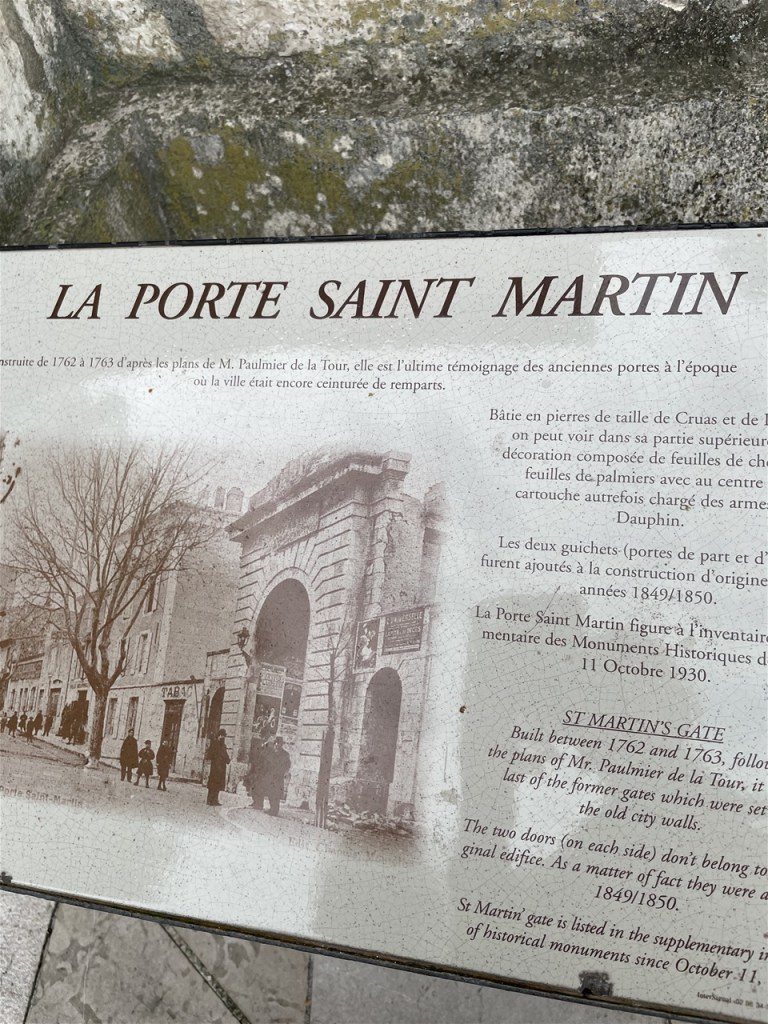
We had parked the car in an otherwise empty side road, no double yellow lines here, and walked into the old town at the top of the Rue Pierre Julien through the last remaining stone gate of the town’s former ramparts, the Porte Saint-Martin. Wandering along the main street, the Rue Pierre Julien, there are plenty of shops dedicated to the sale of nougat, but also many other specialist shops. We came across a tiny art gallery with only three pictures on display. There wasn’t room for a fourth!
We resisted the (supposedly) enticing displays of nougat, the fast food cafes full of chain smoking teenage girls gesticulating wildly and punctuating every sentence with shrieks of laughter and a doughnut shop which smelt like a heart attack in waiting as Marigold had already spotted a few prospects for lunch on the way in.
We ended up in the main square in Montelimar, the Place du March, which still has several of the original arcades and a sparsely attended indoor market in which we found a wine stall where the cheapest bottle on offer was 45 euros. Obviously, a stall holder who offered excellence at a price, but we seemed to be his only browsers. There was no attempt to push his wares, this man had the aura of being content to wait until a true wine connoisseur turned up and found exactly what they were looking for. We weren’t tempted to shell out 120 euros on a bottle of eau de vie.
When we initially moved to France one of the first locals we met was a small Frenchman with a suspiciously red nose. This was Bernard who brought home to us the real meaning of the term subsistence farmer. Bernard just about eked out a living from his tiny patch of land, but his life was an object lesson in ‘making do.’ Eau de vie, literally water of life, was one of his sidelines. In essence it’s a (usually) clear spirit produced in the same way as brandy, but made with fruit instead of grapes. It’s a commercially available product, of course, with an alcohol strength averaging 50%, but in rural France it’s common to find home eau de vie distillers of which Bernard was one.
Bernard’s eau de vie was prodigiously strong, closer to paint stripper than brandy, and his distilling methods were a closely guarded secret. At that time it was legal in France for ‘bouilleurs de cru’ to produce at home 10 litres of ‘pure’ eau de vie or 20 litres of the commercial variant up to 50%. Bernard only made the knock your socks off version.
At any given time he had a maximum of 10 litres available for inspection by the gendarmerie, but we were once allowed to view his hidden stocks under a tarpaulin in a corner of his barn. There were more bottles hidden away in that barn than in a medium sized branch of Victoria Wine.
There was a cheese stall in the market hall too, a very good one, but again heavily concentrating on luxury offerings. There must be a lot of nougat millionaires in Montelimar. Place du March was filled with outdoor cafs and is a pleasant place to sit and enjoy the sunshine. We certainly weren’t the only ones with the same idea.
We noticed an information board referencing the former home of Emile Loubet, former President of France from 1899 to 1906 who was responsible for the split of church and state which is still a key aspect of France’s Republic. We weren’t invited in.
One restaurant, I think it was called two cats, was very noisy and appeared to have a few staff related ‘issues’ as two waiters were pushing and shoving each other on the pavement. The quarrelsome waiters eventually made peace, but one of them kicked over two tables on his way back inside and we heard the sound of glass breaking. We decided it was safer to eat elsewhere.
Marigold picked out her favourite, not a sit down caf at all, more a bread and cake shop with outside tables and I sat down to reserve seats while Marigold went to the counter. While I was waiting for Marigold to finish confusing the bakery assistants I picked up on a rare event: the foursome on a neighbouring table were speaking English. Brits have been conspicuous by their absence on this trip.
This group were middle aged and wearing clothes appropriate for February in Murmansk, but certainly not for Montelimar in the sunshine. I could only hear two of the quartet, but their conversation was memorable enough for me to save it up for Marigold. She likes random conversations that don’t make sense.
First person: ‘How far is it?’
Second person, squinting at the screen of her mobile phone: ‘About twenty miles, I think.’
‘Is that by car?’
‘I suppose so. It doesn’t say. It’s a map.’
‘We won’t bother then.’
‘Okay.’
Very odd. twenty miles is twenty miles, regardless of how it’s travelled. I was unable to eavesdrop further as Marigold returned with a laden tray.
We invariably call places like this a boulangerie, but this one was, technically, a ptisserie’ as they made bread, of course, but also much else besides. In France the designation ‘ptisserie’ is jealously guarded as not anyone can call themselves a ptissier. By law, only those bakers employing a trained and licensed pastry chef can call themselves ptisserie.
As is almost universal in France the cakes and pastries on offer were exceptional and we did them full justice. An hour or so later as we returned to our car we saw the two cats restaurant was still serving meals but large screens had been erected to hide the evidence of previous devastation.
We decided to give the Palais des Bonbons et du Nougat a miss. It’s a block of several museums covering such topics as nougat, sweets in general and toys. We decided our age group was not their target audience. It was impossible to miss a bright pink building on the main road. Diane de Poitiers are well known nougat producers and a ton of nougat a week is churned out inside this pink monstrosity. Like the Palace of Bonbons they offer guided tours but we didn’t go there either.
Forget the nougat connection, Montelimar is a delightful little town, compact enough to wander around but with an enclosed old town, attractive squares, parks, gardens, lots of places to eat and drink and easy parking. It’s win, win.
Another good stop off point that we’ve used many times is Beaune, pronounced ‘Bone.’ Again, like Montelimar, there’s an ancient feel to the place, but it’s much more obvious. Ramparts surround the town and a stroll around the city walls is a great way to unwind if you’ve been stuck in a car for many hours.
Beaune has many stunningly attractive buildings, all well preserved. Our favourite is the remarkable Htel Dieu, also known as Hospices de Beaune. It’s a group of almshouses dating back to 1442 and were built to assist the homeless poor after the devastation of The Black Death when over three quarters of the city’s population perished. There’s a gigantic and extremely prestigious wine auction held here every year. To date we haven’t been invited.
The history of the city dates back to at least Roman times, when a Roman fort was built on the place where Beaune now stands. By the 13th-century, Beaune was the centre of a prosperous wine region with that thriving city in its heart and it’s the Burgundy wine trade that still fuels the economy of the region even now.
They produce a great deal of wine here and the best known is a very small part of the total. The rise and subsequent decline in popularity of Beaujolais amongst wine drinkers has been no great surprise. The marketing gimmick of straight out of the bottling plant Beaujolais Nouveau being flown around the world eventually failed to disguise the fact that Beaujolais is a humble wine extracted from the even more humble gamay grape. The problem was exacerbated when the eminent French wine critic Franois Mauss referred to Beaujolais Nouveau as vin de merde.
Oops.
Beaune’s historic prosperity means it’s packed with impressive mansions and gorgeous timber fronted houses. We’ve never failed to find something to delight us there. Nearby Dijon is the epicentre of the mustard industry. Sadly, I find very little fascination in mustard production so we have never even bothered to visit the Fallon Mustard Mill museum despite driving past it on several occasions. That may be one of the many opportunities we have missed out on. Never mind, we’re not beating ourselves up just because we have little understanding of mustard.

Montelimar is the epicentre of nougat production
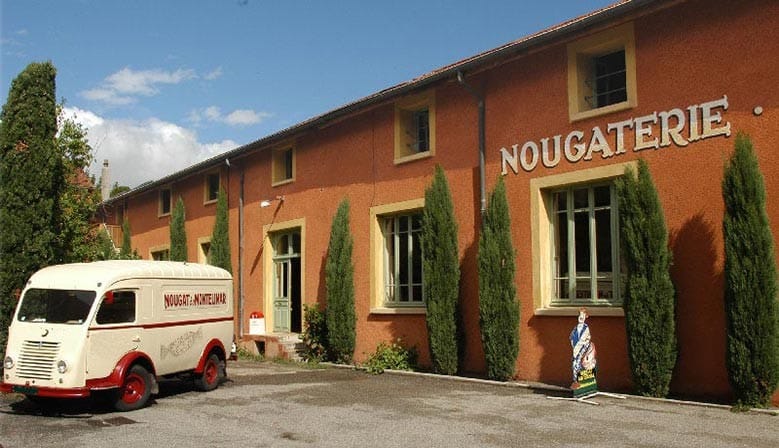
Some producers are refined and traditional
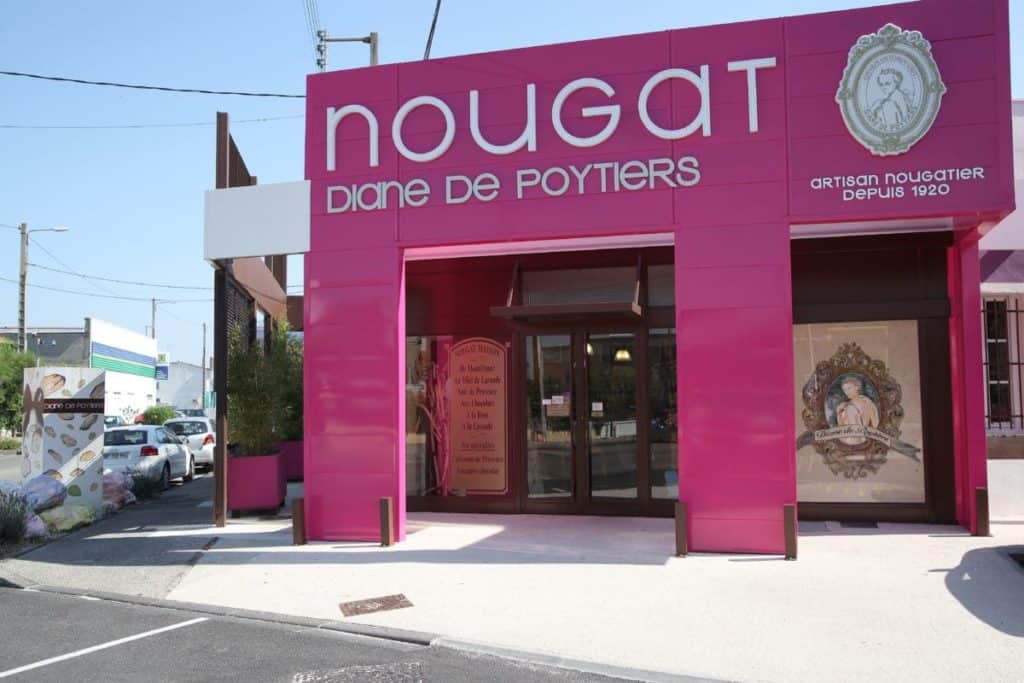
Others rather less refined
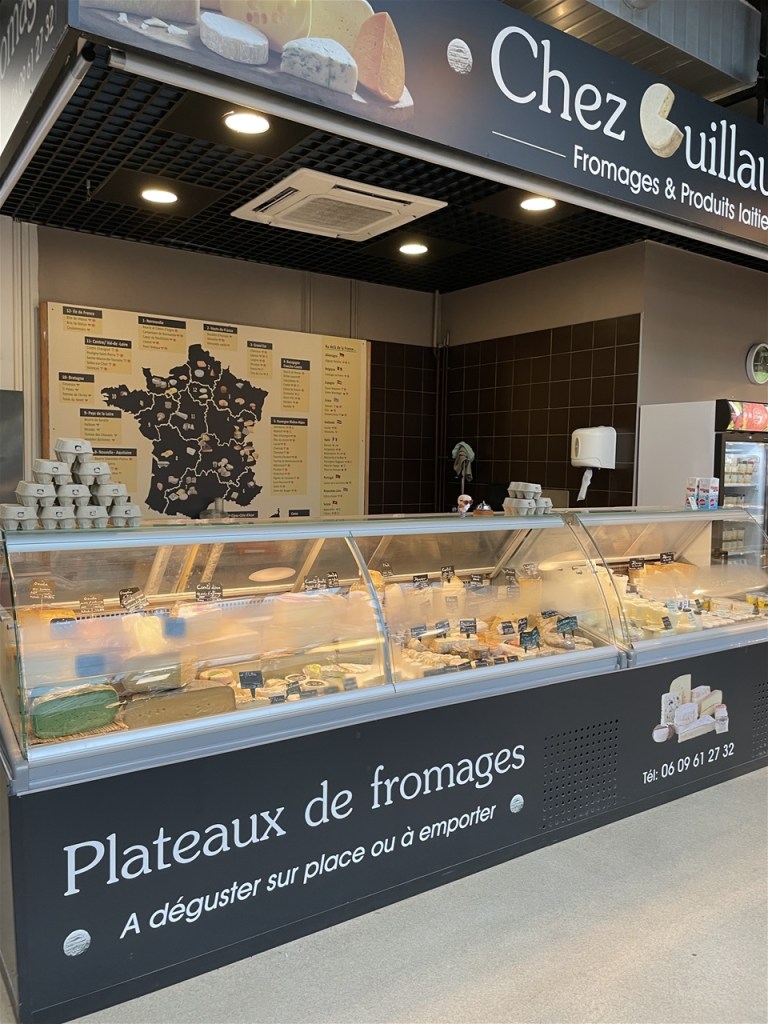
Exceptional cheese stall
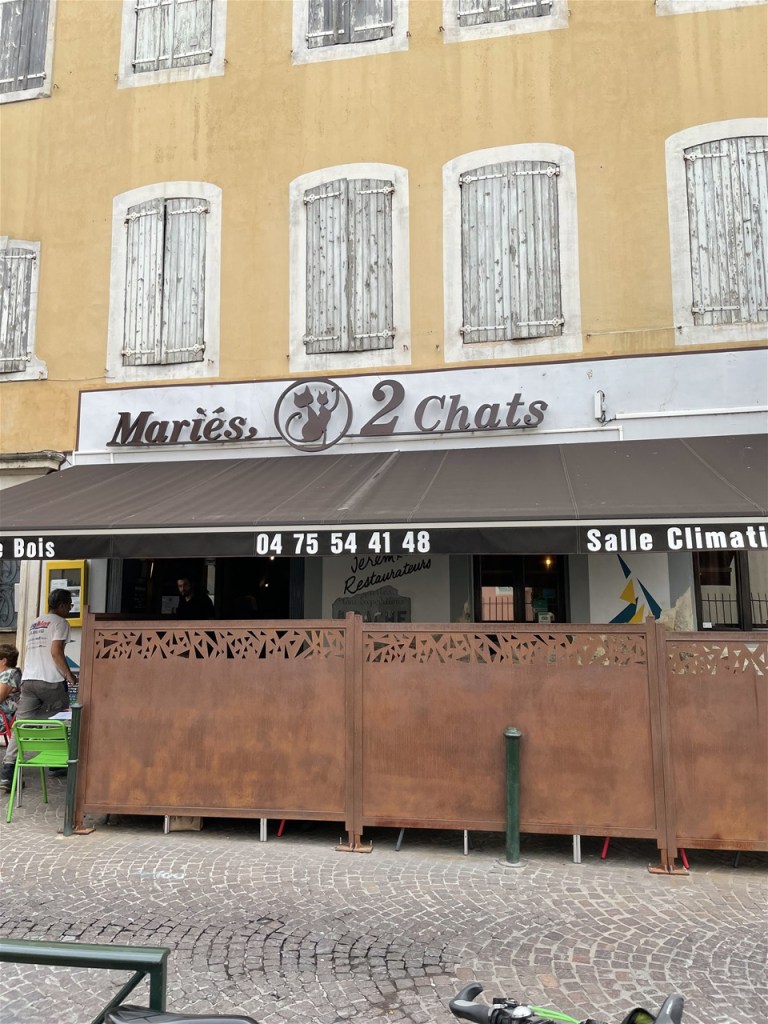
The stroppy waiters having a workplace dispute cafe.
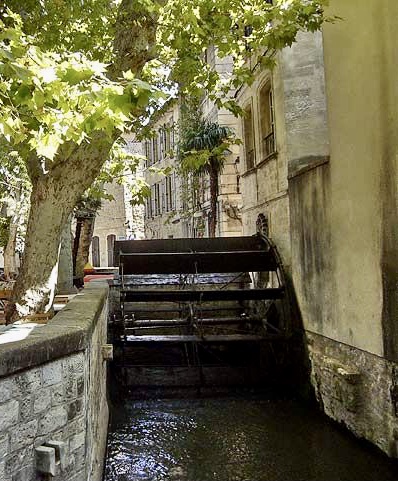
Watermills of Beaune.
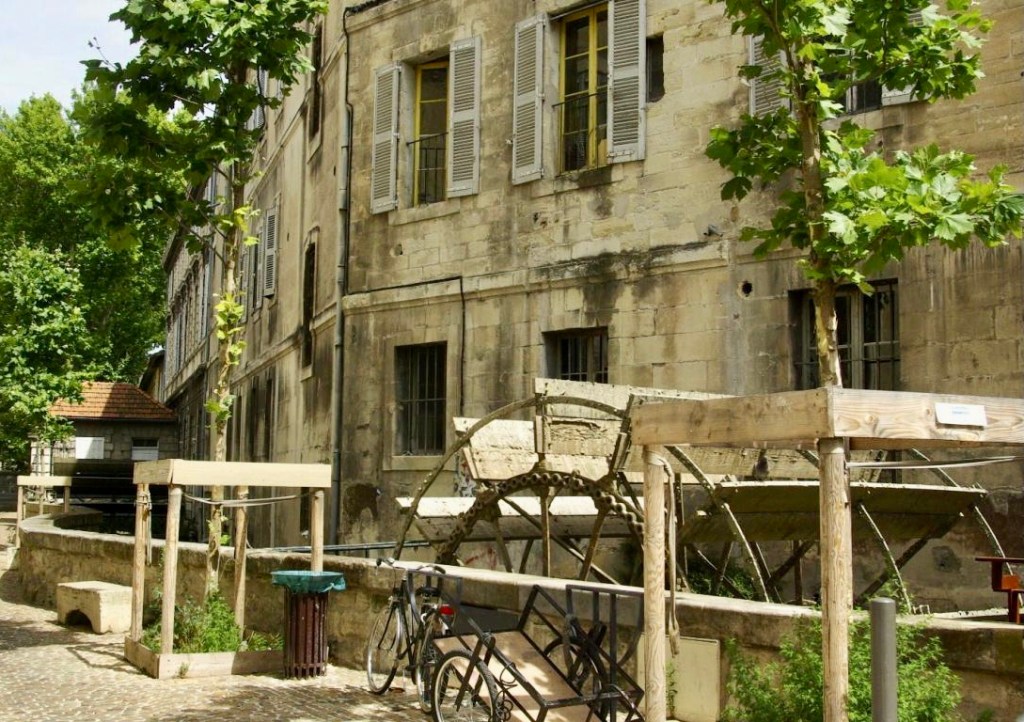
We also missed out on a visit to one of our favourite cities this time. Aix en Provence is delightful. Ah well, next time. We did, however, spend a few hours, just passing through, in Avignon. We first came here at least 40 years ago and it’s still a high point of any visit to France.
That historic and much photographed bridge, the legendary Pont d’Avignon, the vast, imposing Pope’s Palace, Avignon has so much to offer. Avignon’s bridge is actually called Le Pont Saint-Bnzet, named after a 12-year-old shepherd who believed he was instructed by God to build a bridge across the River Rhne in 1177.
Nobody took much notice until the boy demonstrated his divine inspiration by lifting an immense rock above his head. Incredibly, after witnessing that feat of strength the 12 year old was taken seriously enough that the bridge was actually built. It was originally made of wood but replaced by arches of stone a few years later in 1234.
The ‘sur Le pont d’Avignon’ song dates all the way back to the 15th century.
The River Rhne is a mighty beast with a mixed history. It’s brought prosperity to many as a trading artery, but its propensity for flooding has also caused great devastation. In the 1600s an exceptional flood shattered the bridge and only four arches now remain.
We walked along the stunted remnants, in the company of a hundred or so others. It may be a bridge that doesn’t lead anywhere, yet it’s still a major attraction.
Avignon is relatively small, but as we approached there was no missing its dominant feature. Le Palais des Papes dates back to 1252 but was first used in 1309 by the popes in the course of their ‘schism’ ‘ an ecclesiastical version of a family row ‘ with Rome. A succession of nine Popes took up residence here and the Palace is certainly impressive. It’s huge, apparently the largest Gothic building in the world.
Those with keen eyes may notice there are no photographs associated with this visit to Avignon. This is entirely due to vanity. We hadn’t originally intended to go into Avignon and were still dressed in our travelling apparel. Comfort at the expense of style.
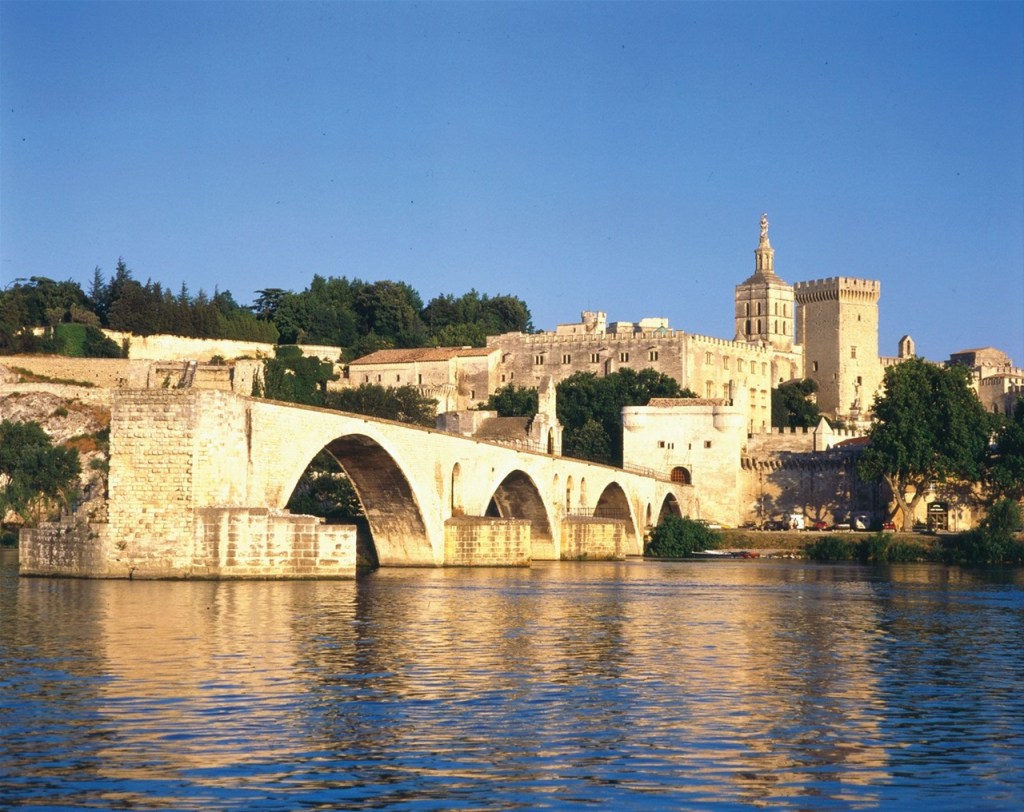
Le pont D’avignon.
We had intended to make a stop at Carcassonne on this trip, so much for intentions, but at least Avignon has an encircling wall. Reading a plaque I was shocked to find the walls around Avignon are over a kilometre longer than those of Carcassonne.
They’re certainly sturdy, standing next to a section of wall is like looking at the North face of the Eiger. If Eight Marigolds stood on my shoulders, scary thought, they might just about reach the top.
We went up for a wander around, not been on the ramparts before, and they are very impressive. With Game of Thrones in mind I have no idea how an enemy force could get into this city.
We met up with a troisime ge group of French pensioners who insisted on speaking English to the English visitors, (troisime ge or ‘third age’ is what the French call people in between middle aged and old age. Their troisime ge clubs are universal, very popular and can be quite lively with much drinking and feasting mixed in with a bit of culture).
We were relieved to be speaking English again, but even so the conversation rarely deviated from the ‘me Tarzan, you Jane’ level. I’m fairly hard of hearing, that aforementioned vanity won’t permit me to go as far as saying I am deaf, so understanding speech is more difficult than it used to be. Magnify that by a hundred when a person is speaking a ‘foreign’ language.
I cope reasonably well with speaking French as long as I can take a moment or two to prepare the actual sentence in advance. Having a French person reply though, that’s where it gets difficult.
Even my spoken French has declined in the twenty years since we ceased to live in France. A French friend, at least I thought she was a friend, recently said to me ‘tu parles francais comme une vache espagnol maintenant’ which means ‘now, you speak French like a Spanish cow.’
Rather harsh, but what a wonderfully expressive phrase.
We’re making our way back to England now, but paid our usual pilgrimage to Chteauneuf-du-Pape, in between Avignon and Orange. We lived quite close to here many years ago and still have friends in the village. They are away at the moment so we missed out on a refreshment break on their terrace.
Chteauneuf-du-Pape is a fairly insignificant village these days, apart from a ruined castle on the top, but has two justifiable claims to fame. It’s of great historical interest having been the ‘Camp David’ style summer retreat for nine Popes, but in more recent times it’s renowned as a cathedral of wine production.
Wine from Chteauneuf-du-Pape was the first recipient of ‘appellation’ status, highly prized in France. Red wine is the classic GSM – Grenache, Syrah and Mourvdre – blend common to most of the lower Rhne region, but as any French person will tell you excellence depends on ‘le terroir,’ the soil in which the vines are planted.
The growing area around here is far removed from good farming land, it’s pebbled and very obviously a legacy of ancient river beds. The extra secret behind a great wine is a profusion of large pebbles known as galets which reflect the sunlight and help retain water.
They have been making wine here for over a thousand years and a bottle of even a basic Chteauneuf-du-Pape is reassuringly expensive. Wine from a ‘great’ year even more so.
I’ve mentioned in this blog on a previous occasion my possession of a 1990 vintage bottle of Chteauneuf-du-Pape, bought soon after we moved to live in France and it has survived numerous house moves since then and remained intact. The treasured bottle is no more. It went off to a new home via a fine wine auction.
Having now received my cheque from the auction house, how I wish I had bought a dozen bottles in 1990, not just one.
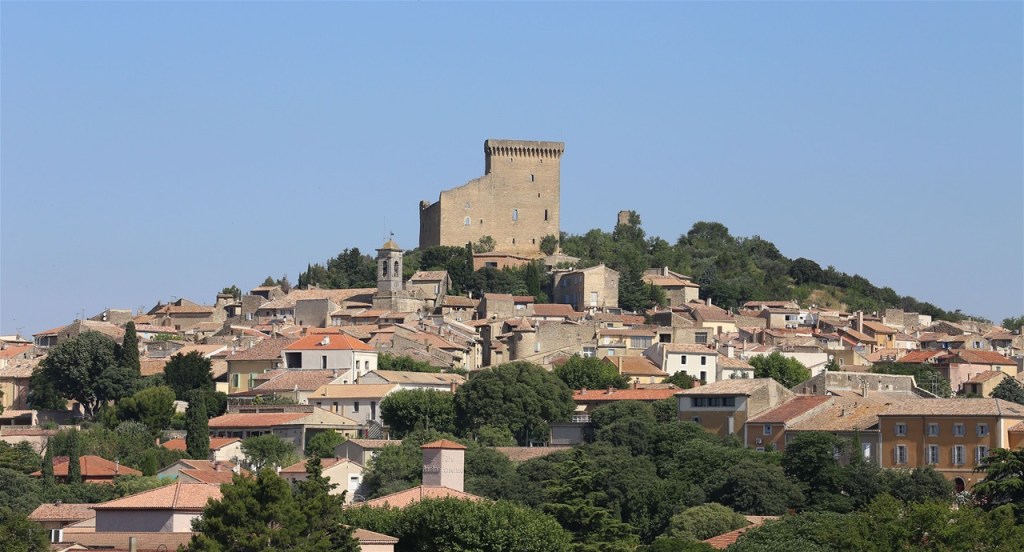
Chateauneuf du Papes. Not much more than a village, but they certainly know how to make wine here.
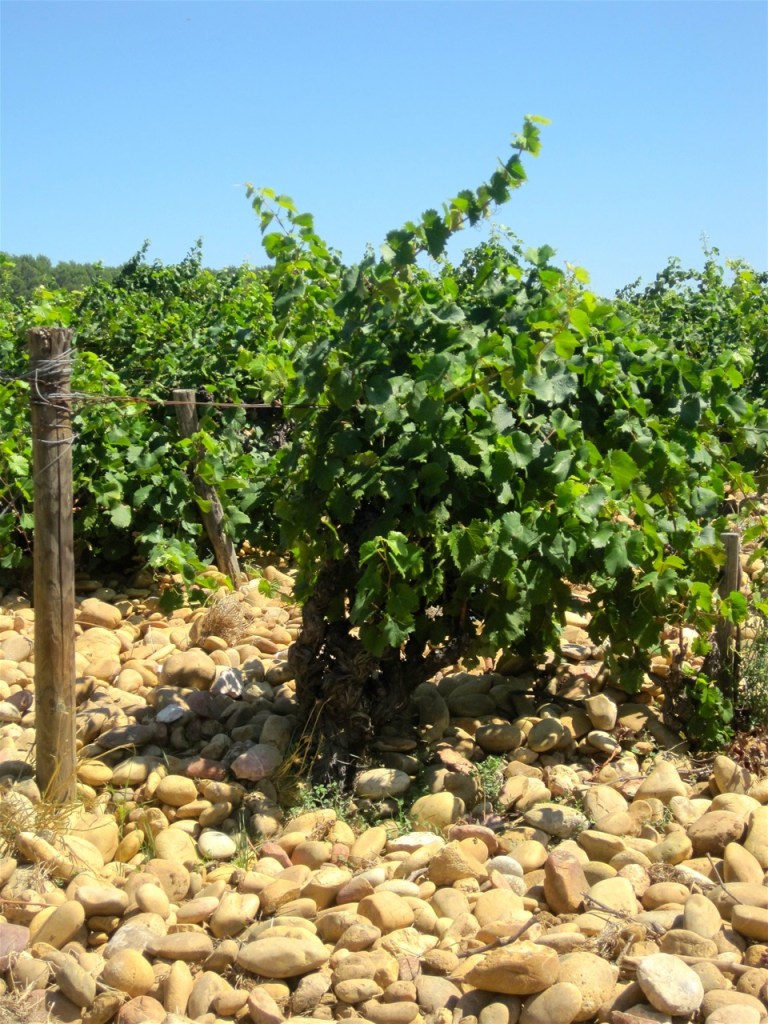
The secret? Plenty of sunshine, no sign of the actual soil, but those stones keep the roots nice and warm.
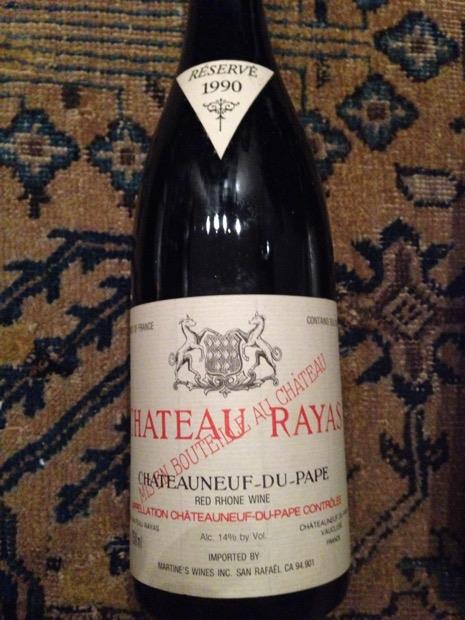
My treasured bottle of wine. Who knows, the new owner may actually drink it.
 Marigold on Tour